You wake up in your Bangkok condo with a line of itchy red welts on your arm and your brain immediately goes to the worst place: bed bugs. Before you panic and throw out your mattress, take a breath. In this city, mosquitoes and ants cause far more bites than bed bugs do, and the three look similar enough that people misdiagnose themselves constantly. This guide walks you through how bed bug bites actually look and behave, how they differ from mosquito and ant bites, and how to confirm what's really biting you before you spend money on the wrong treatment.
At PestsRova we inspect Bangkok homes for biting pests every week, and roughly half the "bed bug" calls we get turn out to be something else. That's good news for the callers, but it also means the reverse happens: people dismiss real bed bug bites as mosquitoes for months while the infestation grows. Getting the identification right early matters.
What Bed Bug Bites Look Like
Bed bug bites are raised, red, itchy welts, usually 2–5 mm across, though they can swell larger if you react strongly. A few features set them apart:
- They appear in lines or clusters. The classic pattern is three bites in a rough row, sometimes called "breakfast, lunch, and dinner." A single bug often probes several spots along a blood vessel before feeding properly.
- They show up on skin exposed while you sleep. Arms, shoulders, neck, face, and legs are the usual targets. Bed bugs rarely burrow under pyjamas or fitted sheets; they take the easy route.
- They arrive overnight. Bed bugs feed almost exclusively at night while you're still. If your bites appear after a day at Chatuchak market, bed bugs are unlikely suspects.
- The itch is delayed. Bed bug saliva contains an anaesthetic, so you don't feel the bite happen. The reaction can take hours or even days to appear, which is why people sometimes blame the wrong hotel or the wrong night.
- Reactions vary wildly between people. Around a third of people barely react at all. Couples sharing a bed where only one person "gets bitten" are common; often both are bitten and only one reacts.
One important caveat: no doctor or technician can conclusively identify a bed bug bite by looking at your skin alone. Bites are evidence, not proof. Proof comes from finding the bugs, their shed skins, or their droppings, which we'll cover below.
Bed Bug Bites vs Mosquito Bites vs Ant Bites
Bangkok has all three biters in abundance, so here's the side-by-side comparison.
| Feature | Bed bug bites | Mosquito bites | Ant bites/stings | |---|---|---|---| | Timing | Overnight, noticed on waking (reaction may be delayed) | Any time, worst at dawn and dusk | During the day, felt immediately | | Pattern | Lines or clusters of 2–5, often in a row | Random, scattered singles | Clustered where ants crawled, often several at once | | Location | Skin exposed during sleep: arms, neck, face, legs | Any exposed skin, especially ankles and legs | Feet, ankles, hands — wherever you touched them | | Sensation | Painless when it happens; itch develops later | Instant itch, welt within minutes | Sharp burning pain immediately, then itch | | Appearance | Flat or raised red welts, sometimes with a darker centre | Puffy, pale bump with red halo, fades within days | Red bump; fire ant stings can form a small white pustule in 24 hours | | Other clues | Tiny blood spots or black dots on sheets | You heard the whine, or found the mosquito | You saw the ants, usually near food or a trail |
A few Bangkok-specific notes on the impostors:
- Mosquitoes are the number-one cause of "mystery bites" here, especially in condos near khlongs, gardens with standing water, or units where the bathroom floor drain has a dried-out water trap. If bites concentrate around your ankles and you get them in the evening on the balcony, that's mosquitoes, not bed bugs. Persistent mosquito problems inside a unit usually trace back to a breeding source within about 100 metres, which is what a proper mosquito control visit hunts down.
- Fire ants and other stinging ants are common in ground-floor gardens, on laundry left outdoors, and along building perimeters. Their stings burn instantly — you will know the moment it happens, which is the opposite of a bed bug bite. Regular trailing ants in your kitchen (pharaoh ants, ghost ants) don't usually bite people at all; they're a nuisance problem handled under general pest control.
- Other suspects worth ruling out: bird mites (if pigeons nest on your balcony or condenser unit), carpet beetle larvae (cause a rash, not bites), and plain heat rash, which Bangkok's climate produces generously.
How to Confirm It's Bed Bugs (Bites Alone Aren't Enough)
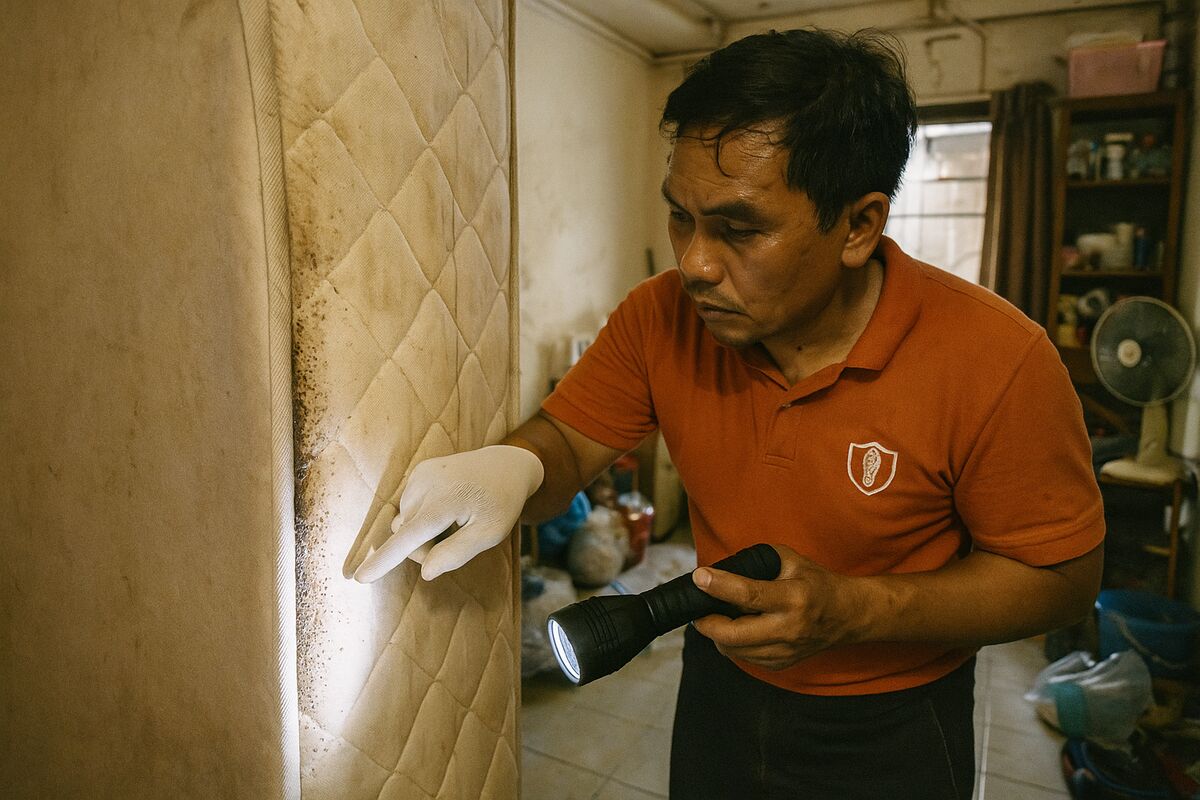
Since skin reactions can't be trusted, look for physical evidence. Bed bugs hide within a metre or two of where you sleep, so the search area is small. Grab your phone torch and check:
- Mattress seams and piping. Run your fingers along the seams, especially at the head end. You're looking for live bugs (apple-seed sized, flat, reddish-brown), pale shed skins, tiny white eggs glued into fabric, and black ink-like spots (droppings).
- The bed frame and headboard. Screw holes, joints, and the gap where the headboard meets the wall are prime real estate. In Bangkok condos, upholstered headboards fixed to the wall are one of the most common harbourages we find.
- Bedding. Small rust-coloured smears on sheets are crushed bugs or blood from feeding. Pepper-like black dots are droppings.
- Nearby furniture. Bedside tables, the sofa if anyone naps there, curtain hems, and the underside of the bed base.
- Skirting boards and outlets within a metre of the bed, especially in older buildings or if a neighbouring unit recently treated an infestation (bed bugs migrate through walls when disturbed).
If you find even one live bug or a patch of droppings, you have an infestation — bed bugs don't visit casually. If you search thoroughly and find nothing after two or three nights of new bites, the odds shift heavily toward mosquitoes or another cause.
Can't tell what you're dealing with? That's genuinely common — and with PestsRova it doesn't matter: treatment is one price by home size, whatever the pest turns out to be. The technician identifies it on arrival and treats it in the same visit, so a wrong guess costs you nothing.
What to Do About the Bites Themselves
Whatever bit you, the first-aid playbook is similar:
- Wash the area with soap and water.
- Apply a cold compress to reduce swelling.
- Use an over-the-counter antihistamine or hydrocortisone cream for the itch — every Bangkok pharmacy stocks both.
- Try not to scratch. In this climate, scratched bites get infected easily.
- See a doctor if you develop signs of infection (spreading redness, warmth, pus) or any allergic reaction beyond local itching.
Bed bugs are not known to transmit disease, which is one small mercy. Mosquitoes in Thailand, on the other hand, can carry dengue — so ironically, the "better" diagnosis of mosquito bites is the one with real health stakes. Take mosquito problems seriously, especially during rainy season.
What to Do If It Really Is Bed Bugs
Here's the part nobody wants to hear: DIY bed bug treatment fails far more often than it succeeds. Supermarket sprays kill the bugs you can see and scatter the rest deeper into walls and furniture. Bed bugs also produce eggs that most consumer insecticides don't touch, so a "successful" DIY job often reboots itself two weeks later, worse and more dispersed.
What actually works:
- Don't move to another bedroom or a friend's place. The bugs will follow you or hitchhike in your bag, and now two rooms are infested.
- Don't throw the mattress out — usually unnecessary after proper treatment, and dragging it through the corridor seeds the building.
- Do wash and hot-dry bedding at the highest heat the fabric allows. Heat above 50°C kills all life stages.
- Do reduce clutter around the bed so treatment can reach every hiding spot.
- Do get professional treatment that includes a follow-up. Eggs hatch over roughly 10–14 days, so any single-visit treatment is incomplete by design.
That follow-up point is why PestsRova's bed bug treatment is priced at the standard size-based rate (from ฿1,590) including a 14-day follow-up visit — the second visit isn't an upsell, it's how the biology works. Treatments use pet- and kid-safe products, you get a photo and treatment report after every visit so you can see exactly what was done, and jobs are done in discreet unmarked vehicles, because your neighbours and your condo's LINE group don't need to know your business. If covered pests return between visits, re-treatment is free.
The Bottom Line
Pattern and timing are your best clues: lines of delayed-itch welts on sleep-exposed skin point to bed bugs; scattered instant-itch bumps on ankles point to mosquitoes; immediate burning pain points to ants. But bites alone never confirm bed bugs — physical evidence in and around the bed does. Search first, then act, and don't waste money treating the wrong pest.
If you've found evidence — or you've searched and still can't explain the bites — get a professional set of eyes on it. PestsRova's English-speaking lead technicians cover every Bangkok BTS and MRT zone, daily from 8:00 to 20:00 with same-day emergency visits until 22:00, and you can book via LINE or WhatsApp in about two minutes. Check current pricing here, and sleep better knowing exactly what you're dealing with.
Frequently asked questions
Can bed bug bites appear during the day?
The skin reaction can show up at any time of day, but the bites themselves almost always happen at night while you are still. Bed bug saliva contains an anaesthetic, so the welt may take hours or days to appear. Daytime biting is rare and usually signals a heavy infestation where the bugs are hungry enough to feed in light.
Why am I getting bitten but my partner isn't?
Most likely you are both being bitten and only one of you reacts. Around one in three people shows no visible reaction to bed bug bites at all. The same applies to mosquitoes. If one partner wakes with lines of delayed-itch welts and the other has nothing, check the mattress seams and headboard for evidence rather than ruling out bed bugs.
Do bed bugs mean my home is dirty?
No. Bed bugs follow people, not dirt. They arrive in luggage after a trip, in second-hand furniture, or through walls from an adjacent condo unit, and spotless Bangkok apartments get them as often as messy ones. Cleanliness affects how quickly you spot the evidence, not whether the bugs turn up in the first place.
How long do bed bug bites take to heal?
Bed bug bites typically heal within one to two weeks if you avoid scratching. Wash the area, apply a cold compress, and use an over-the-counter antihistamine or hydrocortisone cream from any Bangkok pharmacy. New bites appearing after the old ones fade means the bugs are still feeding, which is the point to inspect the bed and book treatment.
Need it handled professionally?
Get a fixed quote for your Bangkok property in under 60 seconds.
Written by the PestsRova Team
We're Bangkok's documented pest control crew — everything we write comes from real treatment visits across homes, condos and short-stay rentals.
Get our Bangkok pest guides straight in Google — add PestsRova as a preferred source.
Add on Google