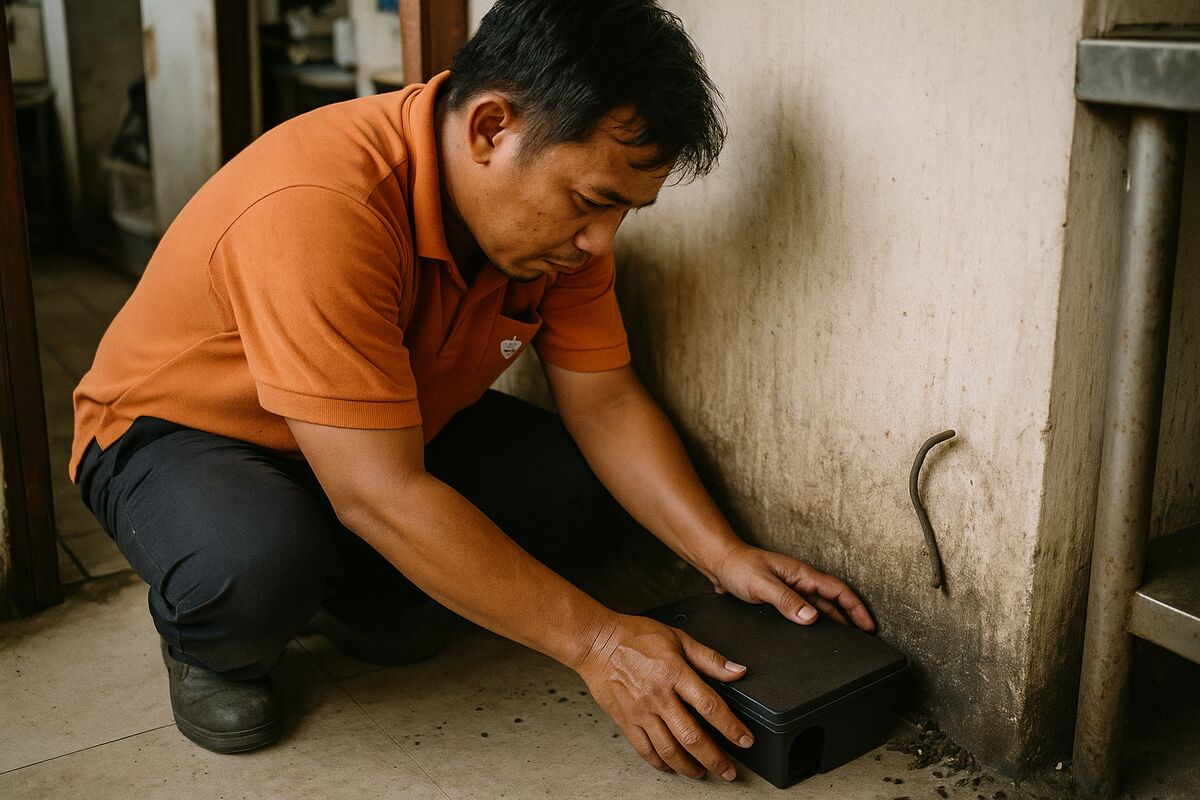
Every city has rats, but rats in Bangkok operate on another level. Anyone who has lived here long enough has a story: the shadow that sprinted across the soi at dusk, the rustle in the false ceiling at 2 am, the surprise guest behind the wet market vegetable crates. This isn't a failure of the city so much as a consequence of what makes Bangkok itself — canals, street food on every corner, tropical warmth, and a building stock full of gaps. Rats didn't get lucky here; the city is practically designed for them.
The upside: rats are predictable animals with predictable needs, and once you understand why Bangkok suits them so well, keeping them out of your own home or business becomes a solvable, step-by-step problem. This guide covers the why, the warning signs, and a practical exclusion plan that actually works — plus where DIY stops working and professional rodent control starts making sense.
Why There Are So Many Rats in Bangkok
Rats need three things: food, water, and shelter with hidden travel routes. Bangkok delivers all three at scale.
- The khlongs. Bangkok's canal network is a rodent superhighway — permanent water, overgrown banks for burrowing, and connections to the drainage system that reach almost every neighbourhood. Properties near khlongs and the river face constant re-invasion pressure no matter how clean they are, because the population next door is effectively infinite.
- Street food culture. The greatest food city on earth is also the greatest rat buffet on earth. Every night market, soi vendor cluster, and wet market generates food scraps, grease, and overflowing bins on a nightly cycle. Rats forage mostly after dark, exactly when vendors pack up and the day's residue sits waiting for morning collection.
- The drainage system. Older neighbourhoods run on ageing drains with broken sections, open gutters, and uncovered floor drains — all of which rats navigate happily. Sewer rats (brown rats, Rattus norvegicus) enter buildings through drainage more often than most people would like to think about, including via ground-floor toilets in old shophouses.
- Climate. No winter means no seasonal die-off. Rats breed year-round here: a female can produce several litters annually with half a dozen or more pups each, and pups reach breeding age in roughly two to three months. Populations recover from any setback with depressing speed.
- Building stock. Shophouses with shared walls and gaps at the roofline, condo waste rooms and pipe risers, false ceilings, air-con penetrations sealed with a prayer and some foam — Bangkok architecture is generous with rodent doorways. A rat can squeeze through a gap the width of a 10-baht coin; a mouse needs even less.
Know your enemy, briefly: Bangkok hosts brown rats (big, burrowing, ground- and drain-dwelling) and roof rats (Rattus rattus — slimmer, agile climbers who run pipes and cables into ceilings and upper floors). The distinction matters because it tells you where to look and where to seal. Ceiling noises usually mean roof rats; drain and ground-floor problems usually mean brown rats.
Signs You Have Rats (Not Just a Neighbourhood Problem)
Rats near your building are a Bangkok constant. Rats in your building announce themselves if you know the signals:
- Droppings — dark, spindle-shaped, 1–2 cm — concentrated along walls, behind appliances, under sinks, and in cupboard corners. Fresh droppings are dark and soft-looking; old ones are grey and crumbly. Location maps their routes.
- Night sounds: scratching, gnawing, or scampering in ceilings and wall voids, typically starting an hour or two after the building quiets down.
- Gnaw marks on food packaging, plastic pipes, cabinet corners, and — dangerously — electrical cable insulation. Rats' incisors grow continuously, so they gnaw constantly; chewed wiring is a genuine fire risk and one of the most expensive forms of rat damage.
- Grease marks: dark, oily smudges along skirting boards and pipe runs where fur repeatedly rubs the same route.
- A musky, ammonia-like smell in enclosed spaces — persistent urine marking.
- Pets acting weird: a cat staring intently at the same cabinet base or ceiling corner night after night is running better surveillance than you are.
- Actual sightings. Rats avoid humans, so seeing one in daylight suggests either a disturbed nest or a population big enough that subordinate rats are pushed into risky daytime foraging. Either way, a daytime sighting means act now.
Beyond the ick factor, this matters for health: rats in Thailand are associated with leptospirosis (spread via urine, a particular risk in flood water), salmonellosis via contaminated food surfaces, and rat lungworm. They also carry fleas and mites into buildings. You don't need to touch a rat to be affected by one; you just need to share a kitchen with its nightly route.
How to Keep Rats Out: Exclusion First, Always
Here's the principle every honest technician will tell you: killing rats without sealing the building is a subscription, not a solution. Bangkok's ambient population refills any vacancy within weeks. Lasting control has a strict order of operations: cut off food, seal the routes, then remove the animals already inside.
Step 1: Starve the route
- Store rice, dry goods, pet food, and snacks in sealed containers — glass, metal, or heavy plastic. Bags of jasmine rice in the bottom cupboard are a standing invitation.
- Take rubbish out nightly, and use bins with tight lids inside and out. If your building's waste room is chaos, that's a juristic-office conversation worth having — one bad waste room supplies a whole building's rats.
- Wipe down cooking areas nightly; grease is calorie-dense and rats love it.
- Feed pets at set times and lift the bowl after. Overnight cat food is rat food.
- Harvest or bin fallen fruit if you have mango, banana, or papaya trees.
Step 2: Seal the building
Work through this checklist with a torch. You're hunting any gap bigger than about 2 cm — and for mice, anything bigger than 6 mm:
| Entry point | What to check | Fix | |---|---|---| | Pipe and cable penetrations | Gaps around air-con lines, water pipes, TV/internet cables through walls | Steel wool or wire mesh packed in, then cement or sealant over it | | Doors | Gap under kitchen and back doors, especially in shophouses | Door sweeps or metal kick plates | | Drains | Uncovered floor drains, broken outdoor drain covers | Metal drain grates/screens; keep water traps wet | | Roofline and eaves | Gaps where roof meets wall, broken vents, missing tiles | Wire mesh, repairs — roof rats' favourite entrance | | Windows and vents | Torn screens, unscreened vents | Repair mesh; add mesh to vents | | Wall bases | Cracks, weep holes, gaps at ground level | Mesh in weep holes (keep airflow), mortar in cracks | | Trees and cables | Branches touching the roof, cable runs onto the building | Trim branches at least a metre back |
Materials matter: rats gnaw through foam filler, plastic, and even soft aluminium. Steel wool, hardware cloth (wire mesh), cement, and metal flashing are the ones that hold.
Step 3: Remove what's inside
Only after steps 1 and 2 is removal worth doing — otherwise you're bailing a boat with the plug out.
- Snap traps work when placed correctly: perpendicular to walls along runways (marked by droppings and grease), bait touching the wall side. Peanut butter, dried fish, or a bit of grilled pork outperform cartoon cheese. Expect rats to avoid new objects for days — that's neophobia, not failure.
- Glue boards are common in Thailand but are both inhumane and unreliable against adult rats; we don't recommend them.
- Poison baits deserve real caution in homes. A poisoned rat often dies inside a wall void or ceiling — the smell is unforgettable and removal can mean opening the ceiling. Worse, secondary poisoning kills pets and the soi cats and dogs that eat dead rats, and open bait is a hazard to kids. If rodenticides are used at all, it should be in locked, tamper-resistant stations placed by a licensed operator — this is exactly why professional programs exist.
- Ultrasonic repellers: rats habituate to them within days. Save your money.
This staged approach — inspection, exclusion, secured removal, follow-up — is what a professional rodent control program actually consists of. PestsRova's rodent service is the same size-based price as any treatment (from ฿1,590), uses pet- and kid-safe methods with tamper-resistant stations, and ends every visit with a photo and treatment report showing what was found, sealed, and placed. And because Bangkok's rat pressure never really stops, the guarantee matters: if covered pests return between visits, re-treatment is free.
Condos, Shophouses, and Shops: Different Buildings, Different Battles
- Condos: your unit is one node in a shared system. Rats travel pipe risers, waste rooms, and false ceilings between floors. Seal your own penetrations (under-sink pipe gaps are the classic), keep the unit food-tight, and push building management on waste handling and common-area gaps — individual unit treatment plus a leaky building equals repeat visits forever.
- Shophouses and townhouses: shared walls and continuous rooflines mean your neighbour's rats are your rats. Prioritise the roofline and rear kitchen area, and coordinate with adjacent units where you can.
- Restaurants, cafés, and food businesses: the stakes are different — one rat sighting in front of customers can undo years of reputation, and inspections are unforgiving. Food businesses need scheduled, documented service rather than reactive call-outs; that's what our commercial pest control programs are built around, reports included for your compliance file.
- Homes with ongoing pressure (khlong-side, near markets, older sois): one-off treatments fight the symptom. A scheduled program keeps stations maintained and gaps monitored — PestsRova's 4-Visit Year Package starts from ฿4,590, which works out to four visits for less than the price of three one-off bookings, and unused visits are refunded. Full details on the pricing page.
The Honest Summary
Bangkok will always have rats — the khlongs, the street food, and the climate guarantee it, and no company promising to "eliminate rats from your area" is being straight with you. What you can absolutely control is whether your building is on their route. Cut the food, seal the gaps with materials that survive gnawing teeth, remove the ones inside safely, and keep watch. Do that, and the city's rats become someone else's problem — ideally no one's kitchen, but at minimum not yours.
Hearing scratching in the ceiling, finding droppings behind the microwave, or running a food business that can't afford a sighting? PestsRova's licensed, insured, English-speaking technicians cover all Bangkok BTS and MRT zones, daily 8:00–20:00 with same-day emergency service until 22:00. Message us on LINE or WhatsApp with a photo of what you've found, and we'll tell you what you're dealing with and exactly what fixing it involves.
Frequently asked questions
How do I know if I have rats in my Bangkok condo or house?
Look for dark spindle-shaped droppings 1–2 cm long along walls and behind appliances, scratching or scampering in ceilings an hour or two after lights-out, gnaw marks on cables and packaging, greasy rub marks along skirting, and a musky ammonia smell. A daytime sighting means the population is large enough to act on immediately.
How much does rat control cost in Bangkok?
PestsRova rodent control is priced by home size, the same as any other pest, from ฿1,590 for a studio up to ฿3,990 for a house per visit. It includes inspection, locked tamper-resistant bait stations or traps, proofing advice and a photo report. Homes with constant pressure near khlongs or markets suit the 4-Visit Year Package from ฿4,590.
What materials stop rats getting into a building?
Steel wool, hardware cloth (wire mesh), cement and metal flashing. Rats gnaw through foam filler, plastic and soft aluminium, so those fail. Pack steel wool or mesh into pipe and cable penetrations then seal over with cement, fit metal door sweeps, put metal grates on floor drains, mesh the weep holes, and trim tree branches a metre back from the roof.
Is rat poison safe to use at home in Thailand?
Loose rat poison is risky in homes. A poisoned rat often dies inside a wall or ceiling void, dead rats cause secondary poisoning of pets and soi cats and dogs, and open bait is a hazard to children. If rodenticides are used at all, they should sit in locked, tamper-resistant stations placed by a licensed operator. Snap traps along runways are the safer DIY option.
Need it handled professionally?
Get a fixed quote for your Bangkok property in under 60 seconds.
Written by the PestsRova Team
We're Bangkok's documented pest control crew — everything we write comes from real treatment visits across homes, condos and short-stay rentals.
Get our Bangkok pest guides straight in Google — add PestsRova as a preferred source.
Add on Google