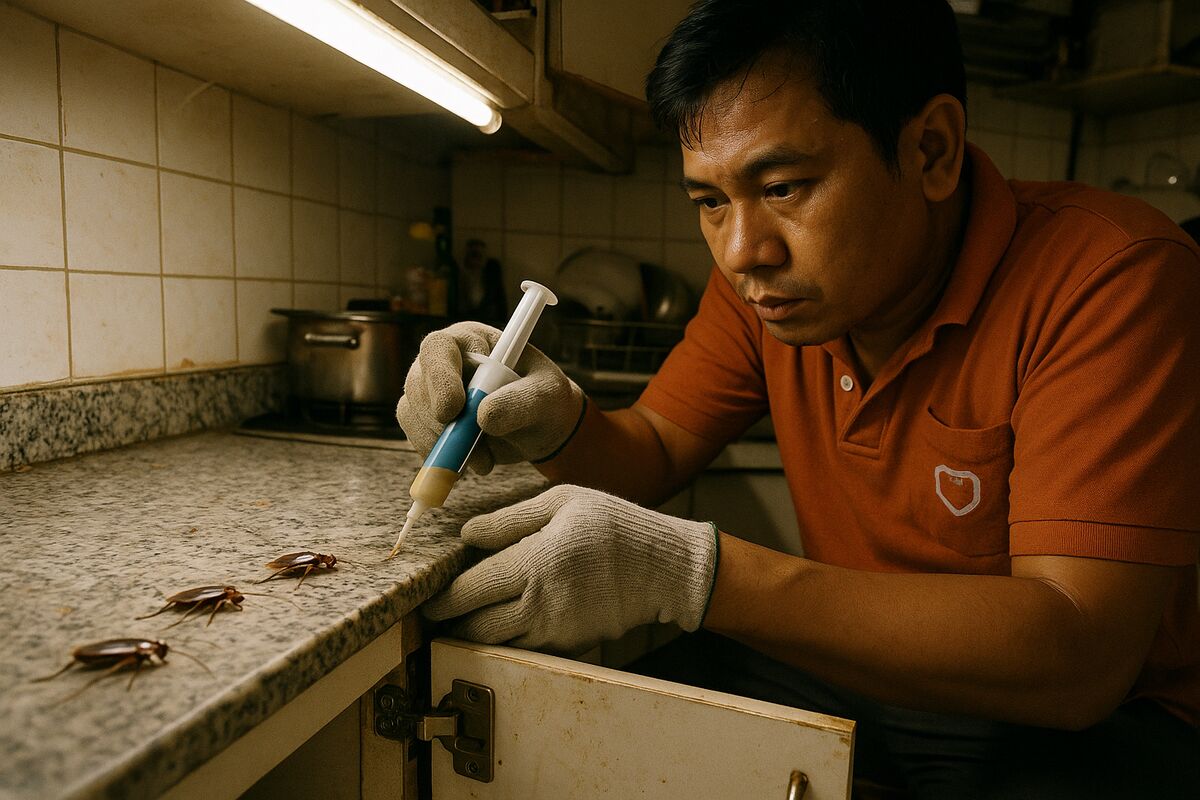
Walk into any 7-Eleven in Bangkok and there's a shelf of aerosol cans promising instant death to anything with six legs. Walk into a condo that a professional just treated and you won't find a single wet surface. Instead you'll find a few dozen tiny dots of cockroach gel bait tucked into hinge gaps, under the sink lip, and behind the fridge kick plate.
Same pest, completely different approach. The difference is not that professionals have a secret spray. It's that they've stopped thinking about the cockroach in front of them and started thinking about the colony behind the wall.
This article explains how cockroach gel bait actually works, why it beats spray in almost every Bangkok home, the few situations where spray still earns its place, and how to avoid the classic mistake of using both at once and cancelling them out.
What a spray actually does (and doesn't do)
Aerosol cockroach sprays are contact insecticides, usually pyrethroids. They work in two ways:
- Direct hit: the droplets land on a cockroach and it dies within minutes. Satisfying, visible, and completely irrelevant to the colony.
- Residual film: the dried spray leaves a layer on the surface that kills insects walking across it for days or weeks, depending on the product and how often the surface gets wiped.
Here's the problem. German cockroaches, the small brown ones that run Bangkok kitchens, spend most of their lives in cracks and voids you can't spray into. A colony lives inside the cabinet carcass, behind the tile gap under the sink, inside the motor housing of the fridge. A spray hits the surfaces around the harbourage, not the harbourage itself.
Worse, pyrethroids are repellent. Cockroaches detect them and avoid treated surfaces. So you've killed the two that were out foraging, and you've taught the other two hundred to take a different route. They don't leave. They relocate eight centimetres to the left.
We wrote a full breakdown of this failure pattern in why DIY cockroach sprays fail, so we won't repeat all of it here. The short version: spray treats symptoms.
How cockroach gel bait works
Gel bait flips the logic. Instead of trying to reach the cockroach, it gets the cockroach to come to you.
A cockroach gel bait is a food-attractant matrix laced with a slow-acting insecticide. The cockroach eats it, walks back to the harbourage, and dies hours later, not minutes. That delay is the entire point. Before it dies, three things happen:
- It defecates in the harbourage. Cockroach faeces contain unmetabolised active ingredient. Nymphs and other adults that eat those droppings (they do; it's called coprophagy) get a dose too.
- It dies in the harbourage. Other cockroaches eat the carcass. Another dose.
- It may regurgitate shared food. Adults feed nymphs in the early instars. More transfer.
This is called the cascade or domino effect, and it's why a few grams of gel can collapse a colony that a litre of spray only scattered. The insecticide reaches cockroaches that never left the wall void.
Common actives in professional gels include fipronil, indoxacarb, hydramethylnon, imidacloprid and dinotefuran. Each has a different speed and transfer profile, and rotating them matters for resistance (more on that below).
Gel bait vs spray: the side-by-side
| | Gel bait | Aerosol spray | |---|---|---| | Kills cockroaches you can't see | Yes, via transfer | No | | Speed of first visible result | 24–72 hours | Seconds | | Colony-level effect | Strong | Weak to none | | Repellent (scatters the colony) | No | Yes | | Residue on worktops and floors | None where food is prepped | Yes | | Safe around pets and kids when placed correctly | Yes, in cracks and out of reach | Caution; airborne droplets | | Works on German cockroaches | Excellent | Poor | | Works on American cockroaches | Moderate (they forage wider) | Moderate as a spot kill | | Cost per treatment | Low material, high skill | Low material, low skill |
The honest summary: spray feels effective and gel bait is effective. One gives you a body to look at, the other gives you an empty kitchen three weeks later.
Why placement is the whole job
Anyone can buy a syringe of gel. What you're paying a technician for is knowing where to put it, because a gel dot in the wrong place is a gel dot nobody eats.
A professional placement in a Bangkok condo kitchen looks like this:
- Dots, not lines. Pea-sized or smaller, many of them. Cockroaches feed at the edge of a placement; a big blob goes stale in the middle.
- In the cracks, not on the open surface. Hinge gaps, the rail under the drawer, the seam where the countertop meets the backsplash, the top edge of the cabinet where it meets the ceiling. German cockroaches like their bodies touching two surfaces at once, so bait goes where two surfaces meet.
- Near water. Under-sink cabinet, dishwasher edge, the gap beside the water-dispenser line. Cockroaches need water more than food.
- Warm spots. The fridge motor housing, behind the microwave, the rice cooker shelf. In an air-conditioned condo these are the colony's heating pads.
- Out of the cleaning path. A dot on a wiped surface disappears with the first cloth. A dot inside the hinge gap lasts weeks.
A good technician in a two-bedroom unit might place fifty to eighty small dots. It takes patience, not product. This is also why our price is flat by home size rather than by pest: the labour is in the walk-through, not the chemical. A studio is ฿1,590 per visit, a 2BR is ฿2,490, and the species is identified on site at no charge.
The mistake that cancels both: spraying over your bait
This one comes up constantly. A tenant has gel applied, sees a cockroach the next day, panics, and empties a 7-Eleven can across the kitchen.
Two things just happened. First, the spray contaminated the gel. Cockroaches won't eat bait that smells of pyrethroid, so every dot in the blast radius is now dead weight. Second, the colony got the repellent signal and pulled back from the foraging routes where the bait was placed.
The result is that the treatment looks like it failed, when in fact it was interrupted. If you've just had gel bait applied:
- Don't spray anything for at least two weeks, ideally the whole cycle.
- Don't wipe inside the cracks where the dots are. Normal surface cleaning is fine.
- Expect to see more cockroaches for a couple of days, sometimes walking slowly in the open during daylight. That's the bait working; dosed cockroaches get disoriented.
- Don't bleach or use strong-smelling cleaners near placements.
If you're in a package with us and you see activity between visits, that's what the free re-treat guarantee is for. Message us on LINE (@pestsrova) rather than reaching for the can.
Bait aversion and resistance: the Bangkok-specific problem
Gel bait has been used in Thai cities for a long time, and German cockroaches evolve fast. Two things go wrong with over-used bait:
Glucose aversion. Some German cockroach populations have developed a genetic quirk where glucose tastes bitter to them. Early gel formulations used glucose as the attractant, and those cockroaches simply refuse it. If you've put out gel and watched cockroaches walk straight past it, this may be why. Modern professional formulations use different sugar bases and rotate attractant matrices.
Active-ingredient resistance. Hammering one active for years selects for survivors. A professional programme rotates between chemical classes across visits. One of the reasons the 12-Visit Year Package works better than twelve random one-off sprays is that the rotation is planned rather than whatever was on the shelf.
Our technicians also pair gel with insect growth regulators (IGRs) in heavy infestations. IGRs don't kill adults; they stop nymphs from maturing into breeding adults, which breaks the population over a generation. Gel handles the adults, the IGR handles the pipeline. We go into more detail on the products we use on our products page.
When spray still makes sense
We're not anti-spray. We're anti-spray-as-the-plan. There are situations where a contact or residual spray earns a spot in a professional kit:
- American cockroaches coming up from drains. The big reddish-brown ones forage over long distances and don't live in your kitchen cabinets the way Germans do. A residual barrier at entry points (floor drain surrounds, the gap under the balcony door) plus drain treatment often does more than gel for that species. Our German vs American cockroach guide covers how to tell them apart.
- Flush-out before baiting. A non-residual flushing agent in a void can reveal where the colony actually is, so the gel goes in the right place.
- Void dusting. Not a spray exactly, but insecticidal dust blown into wall voids and behind skirting is a long-lasting residual that gel can't replicate.
- Commercial kitchens with extreme pressure. A restaurant with a shared drain line and a neighbouring unit that's never been treated sometimes needs a residual perimeter to hold the line while bait does the colony work. Our commercial programmes run this way.
Notice what's missing from that list: "spray the kitchen worktop with an aerosol from the convenience store." That's never the plan.
What a professional visit actually looks like
So you know what you're paying for, here's a typical general pest treatment for cockroaches in a Sukhumvit one-bedroom:
- Inspection with a torch and a flushing agent. The technician checks the usual harbourages, and a few unusual ones (the cable tray above the kitchen cabinets, the aircon drain line, the void behind the washing machine). They identify the species, because German and American need different plans.
- Gel placement. Dozens of small dots in cracks and crevices, species-appropriate formulation.
- IGR if warranted. Typically in established German infestations where egg cases and nymphs are present.
- Targeted residual at entry points. Drain surrounds, pipe penetrations, door thresholds. Not the worktop.
- Advice. Where the colony was, what's feeding it, and whether a neighbouring unit is the source. Bangkok condo stacks share service risers, and one untreated kitchen feeds the whole column. Our condo cockroach-proofing guide covers the building-level side.
- Photo and treatment report. Every visit ends with a report showing what was found, what was placed where, and what to expect. Useful for landlords, juristic offices and your own peace of mind.
The whole thing is pet- and kid-safe when done correctly, because the gel lives in cracks rather than on surfaces, and the residuals go where paws and hands don't.
A realistic timeline after gel bait
Patience is the hard part. Here's what to expect:
- Days 1–3: increased sightings, sluggish cockroaches in the open. Normal.
- Days 4–10: sharp drop in adults. Nymphs still visible.
- Weeks 2–4: nymphs decline as transfer and IGR take effect. Egg cases laid before treatment may still hatch; this is why a follow-up matters.
- Week 4+: ideally zero. If there's still regular activity, either the source is outside your unit or placement needs revising.
A one-time visit carries a 30-day free re-treat if covered pests return. A year package covers re-treats without limit, which is the honest answer for anyone in an older building with a shared riser.
Should you DIY gel bait?
You can, and it'll do more good than spray. Buy a reputable professional-grade gel rather than the convenience-store tube, place small dots in cracks rather than on surfaces, and don't spray afterwards. If you're starting with a handful of sightings in a newer condo, it may be enough.
Where DIY tends to stall is diagnosis. People bait the kitchen when the colony is in the bathroom ceiling void, or bait for Germans when they've got Americans coming up the drain. If you've tried gel for a month and you're still seeing activity, the problem usually isn't the gel.
Ready to stop feeding the colony?
If the spray-and-hope cycle isn't working, book a general pest control visit and we'll do the placement properly. Flat pricing by home size, 15% off your first treatment, photo report at the end, and a technician who'll tell you straight where the cockroaches are actually living. Message us on LINE, WhatsApp, or the contact form, daily 8:00–20:00 with same-day emergencies until 22:00.
Frequently asked questions
Is gel bait better than spray for cockroaches?
Yes, for German cockroaches in a kitchen gel bait is far more effective. Spray kills only the individuals it lands on and repels the rest into cracks, while gel is carried back into the harbourage and spreads through the colony via droppings and carcasses. Spray still has a role at entry points for American cockroaches coming up from drains, but it is never the whole plan.
How long does cockroach gel bait take to work?
Expect the first visible effect within 24–72 hours, often as sluggish cockroaches wandering in the open during daylight. Adults drop sharply between days 4 and 10, nymphs decline over weeks two to four as transfer and any growth regulator take effect, and the kitchen should be clear by week four. Egg cases laid before treatment can still hatch, which is why a follow-up matters.
Can I spray after using cockroach gel bait?
No. Pyrethroid spray contaminates the bait so cockroaches refuse to eat it, and the repellent signal pulls the colony away from the foraging routes where the dots were placed. Do not spray, bleach or use strong cleaners near placements for at least two weeks, ideally the whole cycle. If you see activity after a PestsRova visit, message LINE @pestsrova for the free re-treat instead.
Is cockroach gel bait safe for pets and children?
Yes, when placed correctly. Professional gel goes in pea-sized or smaller dots inside hinge gaps, under the sink lip, behind the fridge kick plate and along cabinet seams, never on worktops or floors where hands and paws go. Unlike aerosols there are no airborne droplets. PestsRova uses pet- and kid-safe products as standard and sends a photo report showing every placement.
Need it handled professionally?
Get a fixed quote for your Bangkok property in under 60 seconds.
Written by the PestsRova Team
We're Bangkok's documented pest control crew — everything we write comes from real treatment visits across homes, condos and short-stay rentals.
Get our Bangkok pest guides straight in Google — add PestsRova as a preferred source.
Add on Google