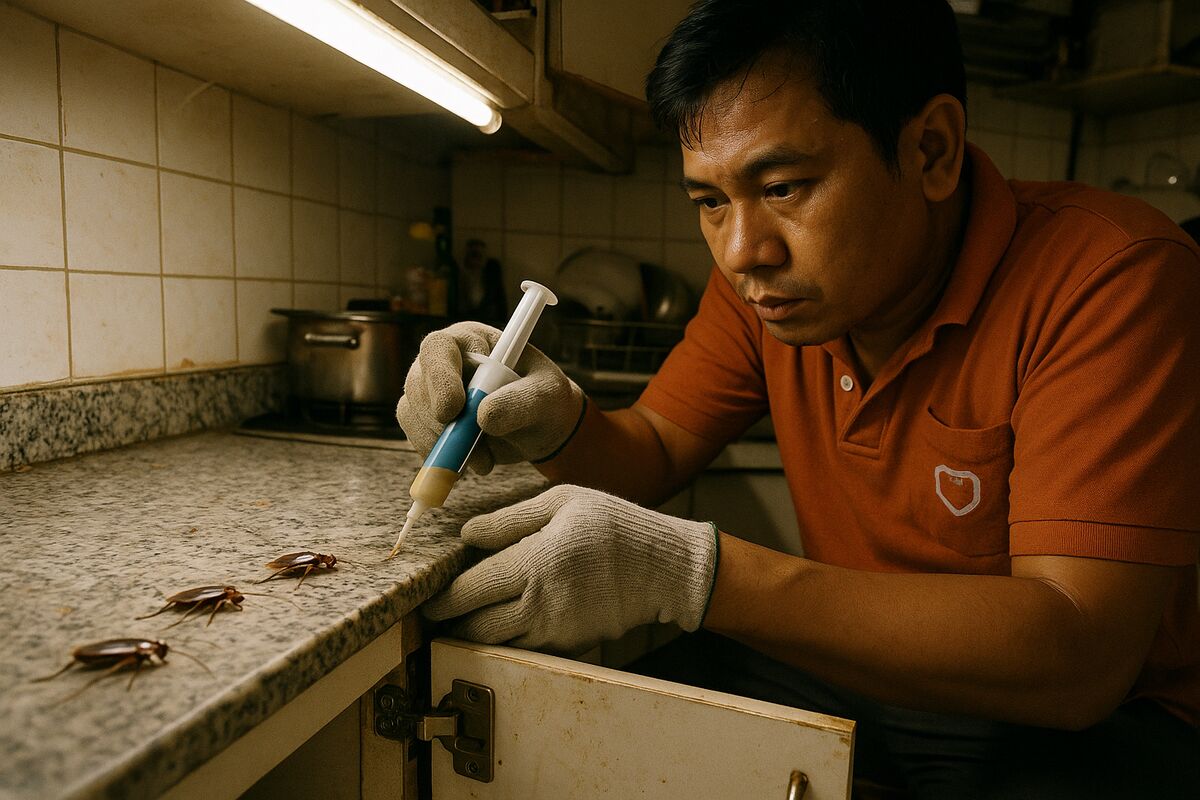
One big cockroach in the kitchen is bad luck. It could have walked in under the door, hitched a ride in a delivery box, or come up the drain. It doesn't necessarily mean anything about your home.
Baby cockroaches are a different message entirely. A nymph can't fly, can't travel far, and hatched from an egg case that was laid somewhere close. If you're seeing tiny cockroaches, the size of a sesame seed up to a grain of rice, you're not seeing visitors. You're seeing residents, and there's a breeding adult within a few metres of where you spotted them.
That sounds alarming, and it should prompt action. But it's also useful information. Baby cockroaches tell you the species, roughly how established the colony is, and where to look. This guide walks through how to identify nymphs in a Bangkok home, what their presence means, and the steps that actually work.
What baby cockroaches look like
Cockroach nymphs are not mini versions of the adult in every respect. A few things to know:
- No wings. Nymphs never have wings. If your "baby cockroach" has wings, it's a small adult of a small species, or it's not a cockroach at all.
- Darker than adults, often. German cockroach nymphs are dark brown to nearly black with a pale stripe down the middle of the back. American cockroach nymphs are greyish-brown at first, shifting to reddish as they grow.
- Tiny. A first-instar German nymph is about 3 mm. A first-instar American nymph is a bit bigger at around 5 mm. Both are easy to mistake for a speck of dirt until it moves.
- Fast. Same scatter reflex as the adults. If you turn on the bathroom light and something small darts toward the skirting, that's a strong hint.
Nymphs grow by moulting. Each stage between moults is called an instar. Immediately after a moult, a nymph is white or cream-coloured for a few hours before the new exoskeleton darkens. "Albino cockroaches" are freshly moulted nymphs, not a separate species.
Which species are you looking at?
In Bangkok homes, baby cockroaches are almost always one of two species. Telling them apart changes the plan completely.
| | German cockroach nymph | American cockroach nymph | |---|---|---| | First-instar size | ~3 mm | ~5 mm | | Colour | Dark brown/black, pale dorsal stripe | Grey-brown, then reddish-brown | | Where you see them | Kitchen cabinets, under sink, behind fridge, near food | Bathroom floor drains, balcony, utility areas, near pipes | | Time from egg to adult | Roughly 6–12 weeks in warm conditions | Roughly 6–12 months | | Number of nymphs per egg case | 30–48 | Around 14–16 | | What it means | Colony is inside your kitchen | Breeding somewhere in the drain or building services |
If you're seeing tiny dark nymphs around the kitchen, that's German, and it's the more urgent situation because of how fast they multiply. If you're seeing slightly larger nymphs around the bathroom drain or laundry area, that's usually American, and the source may be partly outside your unit. Our German vs American guide has adult photos and behaviour if you want to confirm.
Why nymphs mean the colony is close
A German cockroach female carries her egg case (the ootheca) attached to her body until a day or so before it hatches. She doesn't drop it on the other side of the building and wander off. She tucks it into a crack in the harbourage, and 30 to 48 nymphs emerge right there.
Those first-instar nymphs are fragile and stay near the harbourage. They feed on crumbs, grease, and the droppings of the adults. They don't roam the way adults do. So if you see first or second-instar German nymphs on a surface, the harbourage is very likely within a metre or two: inside that cabinet, under that sink, behind that appliance.
American cockroaches are a bit different. The female glues her ootheca to a surface near a food source and leaves it. Nymphs hatch and forage more widely, often along drain lines and pipe chases. Seeing American nymphs in a ground-floor shophouse bathroom usually means breeding in the drain system or a void beneath the floor.
Either way, nymphs are the strongest indicator you'll get that there's an active breeding site, and the place you saw them is your starting point.
How many is "a lot"?
People ask whether a couple of baby cockroaches is a problem. Some rough framing, without pretending it's a precise science:
- One or two nymphs, one time, near a drain: could be a single ootheca that hatched nearby or a batch that came up from the building. Worth a careful look, not a panic.
- Nymphs of different sizes in the same area: multiple generations. The colony has been established for at least a couple of months and is producing continuously.
- Nymphs in daylight, on open surfaces: the harbourage is crowded and they're being pushed out to forage. This is a heavy infestation.
- Nymphs plus droppings (pepper-like specks) plus a musty smell: established German colony. Don't wait.
Because a German female produces several egg cases in her life and nymphs mature within a couple of months in a warm Bangkok kitchen, a handful of nymphs today can be a substantial colony by the end of the season.
What nymphs do NOT mean
A couple of myths to clear up:
- It doesn't mean your home is dirty. Nymphs need water and a crack to live in. A spotless Thonglor condo with a dripping under-sink fitting is a better German cockroach habitat than a messy house with dry cabinets.
- It doesn't mean you can spray them away. Nymphs in the open are a fraction of the population. The rest are in the void, and aerosol doesn't reach them. This is covered in detail in why DIY cockroach sprays fail.
- It doesn't mean the neighbours are necessarily to blame. Condo stacks share risers, and infestations do travel between units. But nymphs in your kitchen means breeding in your kitchen, whatever the original source.
The first 48 hours: what to do when you spot nymphs
Step 1: Note where and when. Time of day, room, exact spot. Take a photo if you can; even a blurry one helps a technician size the nymph and guess the instar. If you book with us, that photo goes straight to the tech via LINE (@pestsrova) before the visit.
Step 2: Check the obvious harbourages nearby. With a torch, look at:
- The hinge side of cabinet doors, where the door meets the carcass
- The underside of the sink and the gap where the pipe enters the cabinet floor
- The back of the fridge near the motor and the drip tray
- The gap between the countertop and the wall
- Inside the rice cooker cabinet and behind the microwave
- The bathroom floor drain and the space under the vanity
You're looking for droppings (small dark specks, like coarse ground pepper), shed skins (translucent husks), empty egg cases (small tan capsules, often with one end open), and the musty, oily smell that comes with a German colony.
Step 3: Remove what's feeding them. Nymphs survive on very little, but denying them is still the right move. Clean grease from the hob surround and the extractor filter, dry the sink overnight, seal pet food, wipe the floor under appliances.
Step 4: Don't spray. Especially if you're about to have a professional in. Spray scatters the colony and contaminates gel bait placements. If you want to do something immediately, a small amount of professional-grade gel bait in the cracks near the sighting is the one DIY move that helps rather than hurts.
Step 5: Book an inspection if it's German. The maths is not on your side with this species. A first-instar nymph you see today could be breeding in eight weeks.
How professionals treat a nymph infestation
A nymph sighting changes the treatment in one important way: it brings insect growth regulators into the plan.
Gel bait and residuals kill adults and nymphs that eat or contact them. But gel alone has a gap: egg cases already laid before treatment are protected inside the ootheca, and they'll hatch on schedule into a kitchen where the bait is already drying out. That's why a single visit sometimes looks like it worked and then "comes back" three weeks later.
An IGR (common ones are hydroprene and pyriproxyfen) doesn't kill anything outright. It mimics a juvenile hormone so nymphs can't complete their final moult into breeding adults. They become deformed, sterile adults, or they stay stuck as nymphs until they die. The colony stops producing the next generation.
A typical PestsRova visit for a German nymph infestation in a Bangkok condo:
- Species and instar identification (included, no charge; you don't need to know what it is before booking)
- Harbourage inspection with flushing agent to find the breeding site
- Gel bait placed in dozens of small dots inside the cracks around it
- IGR applied to the harbourage zone
- Targeted residual at entry points only, not open surfaces
- Photo and treatment report showing what was found and where
Everything used is chosen to be pet- and kid-safe when placed correctly, which in practice means bait inside cracks and nothing on the worktop. Pricing is flat by home size, so a studio is ฿1,590 per visit and a 2BR is ฿2,490, regardless of which species turns up. Full details are on the pricing page.
Why a follow-up visit matters more for nymphs than for adults
This is the bit people skip. If you've seen nymphs, there are almost certainly egg cases in the harbourage that haven't hatched yet. Germans can hatch a new batch every few weeks in a warm kitchen; Americans take longer but the cases are more scattered.
A single treatment handles the current population and starts the IGR effect. A follow-up in two to four weeks catches the hatch that was already in progress, re-baits any placements that have dried, and confirms the harbourage is actually dead rather than quiet.
This is why we structure things around year packages rather than one-offs for anyone with an established colony. The 4-Visit Year Package from ฿4,590 gets you four visits for less than the price of three, and if covered pests return between visits the re-treat is free with no cap. On a one-time visit, the re-treat guarantee runs 30 days. Either way, if nymphs reappear, you're not paying again to deal with them. Unused package visits are refunded, and every package includes a free annual termite inspection, which is a sensible thing to have in a Bangkok building anyway.
Nymphs in a shared building: the condo and shophouse problem
Bangkok's housing stock creates two recurring nymph scenarios.
Condo stacks. Kitchens in a column share a service riser, and the gaps around pipes where they pass through the slab are highways. You can have a clean, treated unit and still see occasional American nymphs coming up because the unit below, or the building's ground-floor bin room, is breeding them. The fix is partly in your unit (seal the penetrations, keep the floor-drain U-trap wet) and partly at building level. Our guide to keeping cockroaches out of a Bangkok condo covers the juristic-office conversation.
Shophouses. Ground-floor commercial with living space above, an open drain at the back, and often a neighbour running a kitchen. German nymphs in an upstairs bedroom of a shophouse usually trace back to a food business on the ground floor, yours or next door's. For commercial premises we run structured programmes with documentation that health inspections accept; see commercial pest control.
Preventing the next batch
Once the colony is dealt with, keeping nymphs from reappearing is mostly about water and cracks:
- Fix drips under the sink and behind the washing machine. A damp cabinet floor is the single best German cockroach nursery in a condo.
- Pour water down unused floor drains weekly so the U-trap stays full.
- Seal the gap where pipes pass through cabinet floors and walls with silicone or expanding foam.
- Keep the extractor filter and the hob surround free of grease.
- Empty the bin daily in rainy season, when pressure from outside is highest.
- Check deliveries and cardboard. Egg cases ride in on boxes more often than people expect.
None of this is complicated, but it's the difference between a one-off treatment that holds and one that "comes back."
Seen a few tiny ones and not sure what they are?
Send us a photo on LINE or WhatsApp and we'll tell you what you're looking at, for free, before you book anything. If it's time for a visit, book general pest control or use the contact form: flat price by home size, 15% off your first treatment, English-speaking lead technician, daily 8:00–20:00, and same-day emergencies until 22:00 across every BTS and MRT zone.
Frequently asked questions
Does seeing baby cockroaches mean I have an infestation?
Usually, yes. Nymphs hatch from an egg case laid nearby and stay close to the harbourage, so seeing them means a breeding adult is within a metre or two. One or two near a drain may be a single hatch from the building's pipes, but nymphs of different sizes, nymphs in daylight, or nymphs with pepper-like droppings mean an established colony.
What do baby cockroaches look like?
Baby cockroaches are wingless, fast and tiny: a first-instar German nymph is about 3 mm and dark brown to black with a pale stripe down its back, while an American nymph is about 5 mm and grey-brown turning reddish. Freshly moulted nymphs look white or cream for a few hours, which is why people report albino cockroaches.
How long does it take for baby cockroaches to become adults?
German cockroach nymphs mature in roughly 6–12 weeks in a warm Bangkok kitchen, which is why a handful today can be a large colony within a season. American cockroach nymphs take far longer, roughly 6–12 months, but their egg cases are glued in more scattered places around drains and utility areas.
Can I get rid of baby cockroaches with spray?
No. Nymphs you see in the open are a small fraction of the colony; the rest are inside cabinet voids and behind appliances where aerosol never reaches. Spray also contaminates gel bait and scatters the colony. A professional visit uses gel bait in the cracks plus an insect growth regulator, with a follow-up two to four weeks later to catch egg cases that hatch after the first treatment.
Need it handled professionally?
Get a fixed quote for your Bangkok property in under 60 seconds.
Written by the PestsRova Team
We're Bangkok's documented pest control crew — everything we write comes from real treatment visits across homes, condos and short-stay rentals.
Get our Bangkok pest guides straight in Google — add PestsRova as a preferred source.
Add on Google