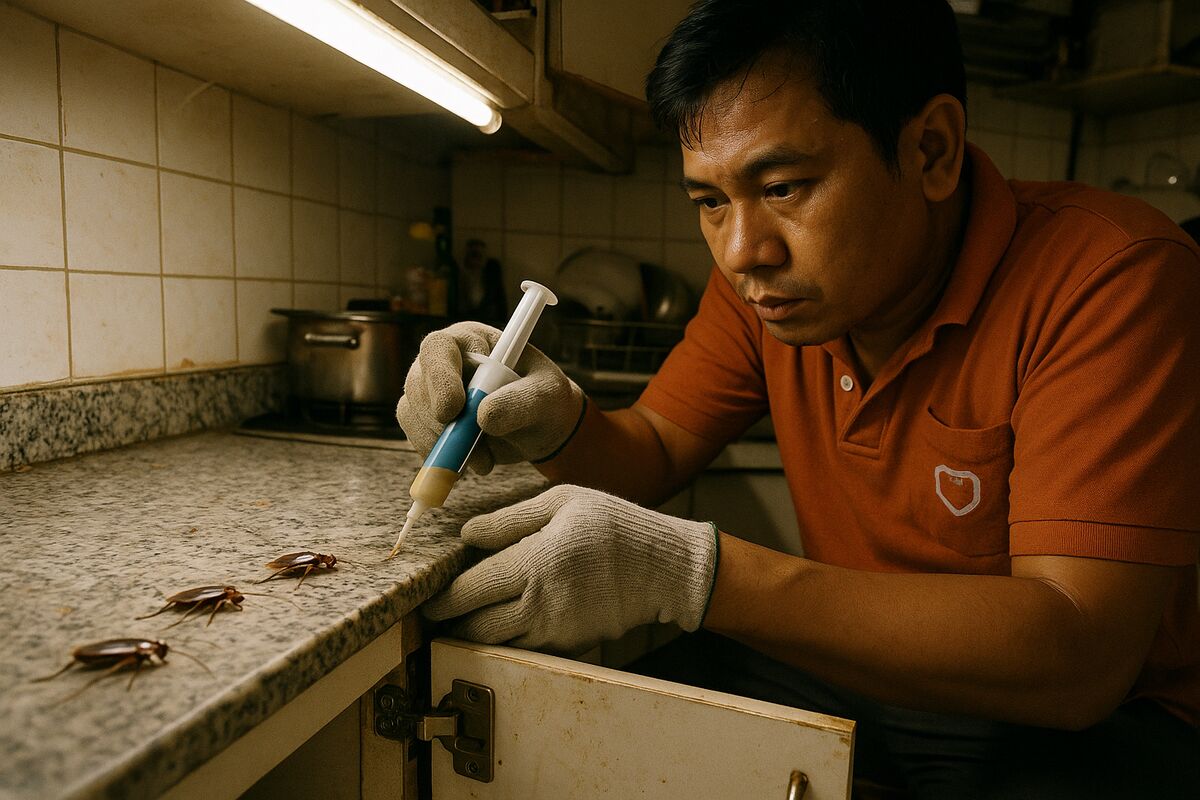
You sprayed. They died. More came. You sprayed again — a different brand this time, the one your neighbour swears by. They died. More came. Now you're standing in the 7-Eleven aisle at 11pm wondering if the answer is the red can or the green can, and searching "cockroach spray not working" on your phone.
Here's the uncomfortable truth: the spray is working exactly as designed. It kills the cockroaches you spray. The problem is that killing the cockroaches you can see was never going to solve an infestation — for reasons that are pure biology, not bad luck or a counterfeit can. This article explains why sprays fail against an established roach population, what the aerosol is actually doing to your odds, and the method that professionals (including us at PestsRova) use instead.
The Iceberg Problem: You're Spraying the Scouts
Cockroaches — especially German cockroaches, the small striped ones that infest Bangkok kitchens — are harbourage animals. The colony lives packed into cracks, voids, hinges, and motor compartments, and only a fraction ventures out at any time, mostly at night, mostly to grab food and water and return.
What that means mathematically: the roaches you see, and therefore the roaches you can spray, are a small minority of the population. Kill every single one you ever lay eyes on and the colony barely notices, because:
- The breeding females rarely leave the harbourage. They sit tight, protected, producing egg cases of 30–40 eggs each.
- No spray kills egg cases. The ootheca's casing shields the eggs from contact insecticides. Every case laid before you sprayed will still hatch on schedule, one to several weeks later. This is the single biggest reason people report "the spray worked for two weeks, then they came back." They didn't come back — they hatched.
- Nymphs spend most of their time deep in cracks, out of reach of anything you can aim.
Spraying visible roaches is treating the symptom at its most literal: you're removing the evidence, not the source.
Repellency: How Your Spray Actively Makes Things Worse
Here's the part almost nobody selling you the can explains. Most supermarket and convenience-store aerosols are built on pyrethroid insecticides, which have a property that's great for a quick knockdown and terrible for solving infestations: they're repellent. Insects detect treated surfaces and avoid them.
When you empty half a can under the sink, three things happen:
- The colony scatters. Survivors and unexposed roaches flee the treated zone — deeper into wall voids, into the next cabinet, sometimes into the bedroom or the neighbouring unit. You haven't shrunk the infestation; you've redistributed it. In a condo or shophouse with shared walls, "I sprayed and now my neighbour has roaches" is not a coincidence.
- You've contaminated future bait sites. This one hurts. Gel bait — the thing that actually kills colonies — only works if roaches willingly walk up and eat it. Bait placed on or near sprayed surfaces gets avoided. A kitchen that's been carpet-bombed with aerosol for months is a genuinely harder kitchen to treat properly, and the first thing a good technician has to do is work around your spray history.
- The survivors are the resistant ones. German cockroach populations worldwide have well-documented resistance to pyrethroids — the exact chemical family in most consumer sprays. Every spraying cycle selects for the individuals that tolerate it. Months of DIY spraying doesn't just fail; it breeds a population your spray can't touch, which is why professionals rotate insecticide classes rather than hammering one.
So the standard DIY loop — see roach, spray roach, feel better, repeat — leaves you with a scattered, spray-averse, increasingly resistant colony, and a kitchen where baits underperform. The spray isn't neutral. It has a cost.
"But the Spray Says It Kills for 6 Months"
Residual claims on cans refer to insecticide persisting on the sprayed surface — and in a Bangkok kitchen, that claim meets three enemies: heat, humidity, and cleaning. Residues degrade fast in our climate, and every wipe-down removes them (which you should be doing anyway, since it's a food area). More importantly, a residual barrier only matters if roaches must cross it, and roaches living inside your cabinet voids don't have to cross the middle of your countertop to survive.
Foggers and "bug bombs" deserve a special mention: they fill the middle of the room with droplets that mostly never enter the cracks where roaches actually are, while maximising the scatter-and-contaminate effects above, plus coating your dishes and counters. For infestations, they're arguably the worst tool per baht sold.
What Actually Works: Baiting the Colony Against Itself
Modern cockroach control flipped the logic. Instead of chasing roaches with poison they avoid, you offer poison they seek out — and let their own biology distribute it.
How gel bait works:
- The bait is a food matrix laced with a slow-acting, non-repellent insecticide. Roaches find it attractive and eat it voluntarily.
- Slow-acting is the feature, not a flaw. The roach walks back into the harbourage before dying — right in the middle of the colony.
- Then the grim magic: roaches are cannibals and coprophages. They eat their dead and each other's droppings. One bait feeding kills the eater, then secondarily poisons the colony members who scavenge the remains. Nymphs that never left the crack die from a bait dot they never visited. The kill cascades to exactly the roaches your spray could never reach.
How to bait properly:
- Many tiny dots, not big blobs. Rice-grain sized placements, lots of them — cabinet hinges, drawer runner gaps, under-sink pipe entries, behind the fridge, the wall–counter junction. Roaches feed near home; the bait must be within their short foraging range.
- Follow the droppings. Pepper-like specks mark the harbourage. That's where dots earn their keep.
- Zero spraying anywhere near bait. If you take one sentence from this article: baits and sprays are enemies. Pick baits.
- Starve the competition. Bait competes with your crumbs. The cleaner the kitchen (dry sink at night, sealed food, degreased surfaces), the faster roaches take the bait.
- Refresh and be patient. Bangkok humidity crusts gel within a couple of weeks; replace it. Expect visible decline over 2–4 weeks, with stragglers as pre-existing egg cases hatch into a baited environment and die in turn.
- Use sticky traps as scoreboards. They won't control anything, but they tell you honestly whether the population is falling.
Consumer gel baits from HomePro or Villa are a legitimate middle step and vastly outperform any spray. Quality varies, and roach populations can develop bait aversion to specific formulations — if dots go untouched for a week while traps stay busy, the bait, not the concept, is the problem.
What About Natural Remedies and Gadgets?
Since the spray shelf's neighbours deserve a verdict too:
- Boric acid — the one folk remedy with real science behind it. Dusted very lightly in dry, hidden voids, it kills roaches that walk through it and groom it off. The catches: people apply visible piles (roaches walk around them), it clumps uselessly in Bangkok humidity, and it must stay away from kids, pets, and food surfaces. Useful in the right hands; usually misapplied.
- Baking soda and sugar, cucumber peels, pandan or bay leaves — ranging from marginal to pure folklore. Nothing here dents a breeding colony.
- Ultrasonic repeller plugs — repeatedly tested, repeatedly found to do nothing. Roaches will nest behind the device.
- Roach houses / sticky traps — genuinely worth buying, but as monitoring, not control. They tell you where activity is and whether your baiting is winning. They will never out-trap a colony's breeding rate.
- Lime, chalk lines, and "magic" powders from the market — repellent at best, which by now you know means: they relocate the problem and sabotage your baits.
The pattern is consistent: anything that repels works against you, anything that kills-on-contact only reaches the visible minority, and the only tools that reach the colony are the ones roaches carry home themselves.
When Baiting Alone Isn't Enough
DIY baiting genuinely clears light-to-moderate German roach problems. But some situations outgrow it:
- Daytime sightings, egg cases, or a musty cabinet smell — markers of a large, established population where DIY bait volume can't keep up with breeding.
- Bait-averse populations — you need rotation between bait formulations and insecticide classes, which is a professional's toolkit.
- A spray-saturated kitchen — months of aerosol history means placements need experience to work around contamination.
- Building-source problems — if roaches pour in from a garbage room or shared drains, unit-level baiting is a treadmill. (Big roaches appearing after rain are a different species and a different problem entirely — see our German vs American comparison.)
- Kids, pets, asthma at home — you want precise, minimal, correctly-placed product, not escalating chemistry. Pet- and kid-safe products are standard on every PestsRova job, and baiting-first is exactly why: targeted dots in hinges beat clouds of aerosol in a food area every time.
Professional treatment is the same philosophy executed with better tools: professional-grade baits rotated to defeat aversion, crack-and-crevice injection into the voids where colonies actually live, insect growth regulators that stop nymphs maturing, and drain treatment where needed. Our general pest control service starts at ฿1,590 for a studio — full prices are on the pricing page — and every visit ends with a photo and treatment report showing where everything went and why. If covered pests return between visits, the re-treat is free, which tells you how confident the method makes us.
The Honest Comparison
| | Aerosol spray | Gel bait (DIY) | Professional treatment | |---|---|---|---| | Kills visible roaches | Yes, instantly | Slowly | Yes | | Reaches the colony | No | Yes, via transfer | Yes, bait + crevice injection | | Effect on egg cases | None | Kills hatchlings as they feed | Kills hatchlings + IGRs stop maturation | | Risk of scattering colony | High | None | None | | Resistance/aversion handling | Makes it worse | Limited | Class and bait rotation | | Food-area safety profile | Poor (broadcast residue) | Good (targeted dots) | Good, kid- and pet-safe as standard | | Cost | ฿100–200/can, repeatedly, forever | ฿200–500, occasionally | From ฿1,590, guaranteed between visits |
The can has one legitimate use: the single wandering roach you want dead right now, in a spot far from any baiting area. As a strategy against an infestation, it's a subscription to your own problem.
If you've been through three brands of spray and the roaches are still winning, that's not failure — that's the predictable result of the wrong tool, and it's fixable. Message PestsRova on LINE or WhatsApp (daily 8:00–20:00, same-day emergencies until 22:00) and a licensed, English-speaking technician will switch your kitchen onto the strategy that actually ends this — book here. Put the can down. The roaches have seen enough of it.
Frequently asked questions
Why does cockroach spray not work?
Because it only kills the few roaches that leave the harbourage, while breeding females and nymphs stay hidden in cracks and no spray penetrates egg cases. Most consumer aerosols are also repellent pyrethroids: they scatter survivors deeper into walls or next door, contaminate the surfaces where bait would work, and select for resistant individuals, so each cycle leaves a harder infestation.
What kills cockroaches better than spray?
Non-repellent gel bait. Roaches eat it voluntarily, walk back into the harbourage before dying, and poison nestmates that scavenge the remains, so the kill reaches nymphs and females that never left the crack. Place many rice-grain dots in hinges, drawer runners, under-sink pipe entries and behind the fridge, keep the kitchen clean so bait wins, and never spray near it.
How long does gel bait take to get rid of cockroaches?
Expect visible decline over 2–4 weeks. Bait kills slowly by design, and stragglers appear as pre-existing egg cases hatch into a baited kitchen and die in turn. Bangkok humidity crusts gel within about two weeks, so refresh placements, and use sticky traps as a scoreboard. If dots go untouched while traps stay busy, switch formulation because the population is bait-averse.
How much does professional cockroach treatment cost in Bangkok?
PestsRova charges one flat price by home size regardless of pest: ฿1,590 for a studio, ฿1,990 for a one-bedroom, ฿2,490 for two bedrooms, ฿2,990 for three bedrooms and ฿3,990 for a house, with 15 percent off the first treatment. Every visit uses pet- and kid-safe professional baits with crack-and-crevice injection, and if roaches return between visits the re-treat is free.
Need it handled professionally?
Get a fixed quote for your Bangkok property in under 60 seconds.
Written by the PestsRova Team
We're Bangkok's documented pest control crew — everything we write comes from real treatment visits across homes, condos and short-stay rentals.