Most people in Bangkok treat cockroaches as a nuisance to be managed rather than a problem to be solved. A couple a week in the kitchen, a big one on the balcony after rain, a spray can under the sink for emergencies. Live and let live. That approach is understandable in a city where cockroaches are everywhere, but it ignores the one reason that should change the calculation: cockroach allergy.
Cockroach allergens are a recognised trigger for asthma and allergic rhinitis, and they are particularly associated with asthma in children living in urban homes. The allergens are not in the bite (cockroaches rarely bite) and they are not transmitted by touch. They are in the dust. Cockroach droppings, shed skins, saliva and body fragments break down into tiny particles that settle in carpets, bedding, soft furnishings and kitchen corners, and get stirred into the air every time someone walks past or switches on a fan. If someone in your home has a persistent cough, wheezing at night, or allergies that never quite clear up, the cockroaches you have been tolerating may be part of the reason.
This article explains what cockroach allergens are, why Bangkok homes accumulate them so effectively, who is most affected, and what actually reduces the allergen load. Spoiler: it is not the spray can.
What is a cockroach allergy?
A cockroach allergy is an immune response to proteins produced by cockroaches. The best studied come from the German cockroach (Blattella germanica) and the American cockroach (Periplaneta americana), which happen to be the two species that dominate Bangkok homes. The proteins are found in:
- Droppings (frass). The small dark specks you see along cupboard edges and behind appliances.
- Shed skins. Cockroaches moult several times as they grow. Each cast skin is a packet of allergen.
- Saliva and secretions. Left on every surface a cockroach feeds from or walks across.
- Dead bodies. A dead cockroach behind the fridge keeps contributing allergen for a long time as it dries and crumbles.
Once these materials dry out, they fragment into particles small enough to become airborne and be inhaled. They then settle into dust, which is why cockroach allergen can be measured in homes long after the live cockroaches have gone.
For a sensitised person, inhaling the allergen triggers the familiar allergic cascade: sneezing, runny or blocked nose, itchy eyes, and in people with asthma, airway inflammation that leads to coughing, wheezing and shortness of breath. Public health bodies list cockroaches alongside dust mites, mould and pet dander as a major indoor asthma trigger. Sensitisation to cockroach allergen has been linked to more severe asthma and more frequent hospital visits in children living in cockroach-infested housing.
Why Bangkok homes are a perfect allergen reservoir
Cockroach allergen is a problem in cities worldwide, but Bangkok's conditions stack the deck.
- Year-round warmth and humidity mean cockroach populations breed continuously with no winter die-off.
- Dense housing (condo stacks, shophouses, townhouse rows) shares plumbing and walls, so a population in one unit feeds neighbours.
- Open drains and traps in older bathrooms give cockroaches a permanent highway into the home.
- Air conditioning encourages sealed rooms where dust accumulates, with fans recirculating whatever is on the floor.
- Soft furnishings and clutter in small units (rugs, sofas, stored cardboard, under-bed storage) trap allergen-laden dust.
- A culture of tolerance. Because a few cockroaches are seen as normal, populations are often allowed to persist for years, and the allergen load keeps building.
The German cockroach deserves particular attention here. It does not fly in from outside; it breeds inside the kitchen, producing dozens of nymphs per egg case, moulting repeatedly, and depositing frass in the exact cupboards where you store food. A small, tolerated German cockroach population is a continuous allergen factory a few feet from where you eat. Our comparison of German vs American cockroaches in Thailand explains how to tell which you have.
Who is most at risk from cockroach allergens?
Anyone can become sensitised, but some people carry much more of the burden.
- Children with asthma. This is the group where the association is strongest and best documented. Children spend more time close to the floor, breathe faster relative to their size, and their airways are smaller and more reactive.
- Anyone with existing allergic disease. If you already react to dust mites or pollen, you are more likely to become sensitised to cockroach allergen too, and the combined load worsens symptoms.
- People who spend long hours at home. Remote workers, elderly family members and carers get the highest cumulative exposure.
- Families in older buildings. Shophouses, low-rise walk-ups and older condos with open drains tend to carry heavier cockroach populations.
- People with unexplained "sinus" problems. Persistent congestion, post-nasal drip and a cough that lingers for months are often blamed on Bangkok's air. Sometimes the air in question is the air inside the apartment.
A clue that cockroaches may be involved: symptoms that are worse at home than at the office or while travelling, worse at night or first thing in the morning, and worse in the kitchen and bedroom than on the balcony.
How to tell whether you have an allergen problem
There are two halves to this: the medical side and the home side.
The medical side
An allergist can confirm sensitisation with a skin-prick test or a blood test for specific IgE antibodies to cockroach allergen. Major Bangkok hospitals offer allergy panels that include cockroach as standard, and it is a reasonable test to ask for if a child's asthma is poorly controlled. A positive test tells you reducing exposure is likely to help; a negative one tells you to look elsewhere.
The home side
Even without a test, a short inspection tells you a lot. Look with a torch, at night, in these places:
- Behind and under the fridge, especially the compressor area where it is warm.
- Inside the cupboard under the sink, along the back edge and around the pipe entry.
- The hinges and top edges of kitchen cupboard doors.
- Behind the microwave, rice cooker and kettle.
- The bathroom floor drain and the gap behind the toilet.
- Under-bed storage boxes and behind the bedroom wardrobe.
You are looking for live cockroaches, dark pepper-like droppings, smear marks, shed skins and egg cases. If you find droppings in more than one location, you have a resident population and an allergen source.
Reducing cockroach allergen: what works and what doesn't
The research on allergen reduction points to a clear order of operations. Get rid of the cockroaches first, then clean up the allergen they left behind, then stop them coming back. Doing it in a different order wastes effort.
Step 1: eliminate the population
Spraying visible cockroaches does not reduce the allergen load and often makes it worse. Aerosol sprays scatter a population into new hiding spots, kill only the individuals you can see, and leave the frass, skins and bodies behind the fridge untouched. Worse, repeated spraying adds chemical residue to the same dust you are trying to clean. Our article on why DIY cockroach sprays fail goes into the mechanics.
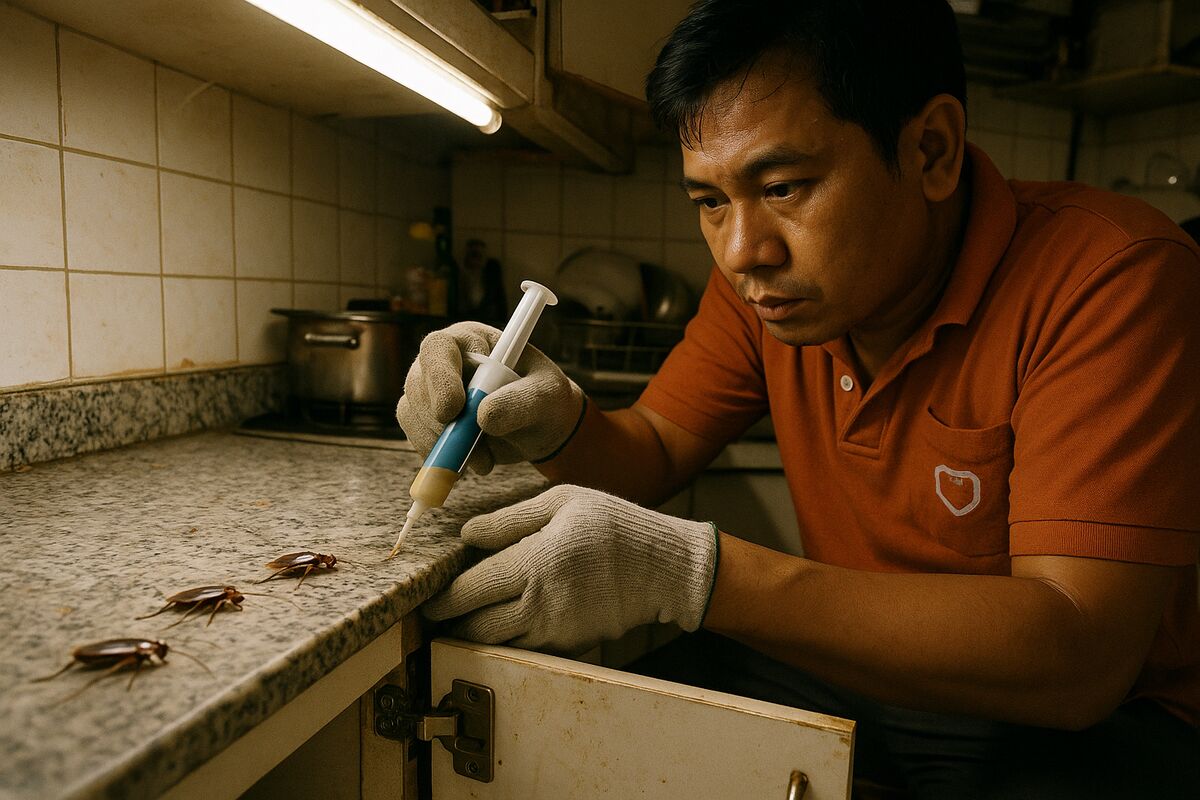
What does work is targeted gel baiting. Bait placed in the harbourages is carried back to the nest and spreads through the population, including the nymphs you never see. Combined with an insect growth regulator to stop nymphs maturing and a residual treatment on the entry routes, this removes the population rather than rearranging it. A professional treatment takes about an hour for a typical condo and, because pricing is flat by home size, identification of the species and advice on the source are included in the price.
For a household with an asthmatic child, it is worth being explicit with the technician about the health reason. Ask for low-odour gel baits rather than broadcast spraying, and for placement that keeps bait well away from where children play. PestsRova uses pet- and kid-safe products as standard and will walk you through exactly where everything has gone.
Step 2: remove the allergen reservoir
Dead cockroaches and frass continue to shed allergen for months. Once the live population is gone, the clean-up is where the health benefit actually comes from.
- Vacuum with a HEPA filter, slowly, along cupboard edges, behind appliances, under beds and along skirting boards. A standard vacuum without a fine filter can blow the smallest particles back into the air.
- Wash bedding, curtains and removable covers at the hottest setting the fabric allows.
- Wipe hard surfaces with warm soapy water. Pay attention to the tops of cupboards and the backs of appliances.
- Pull out the fridge and cooker and clean underneath. This single step removes more allergen than any other in most kitchens.
- Throw out cardboard boxes that cockroaches have lived in. They cannot be cleaned and they are a favoured harbourage.
- Replace or deep-clean rugs in the bedroom of any affected child.
If the cleaning job is bigger than you want to take on, our sister company CleanRova handles deep cleans, and the two services can be scheduled back to back.
Step 3: prevent re-infestation
Allergen reduction only lasts as long as the cockroaches stay away. The standard condo prevention list applies: mesh drain covers, wet traps, sealed pipe gaps, door sweeps, and dry goods in sealed containers. Our guide to keeping cockroaches out of a Bangkok condo covers the unit-level fixes.
For households with a sensitised family member, a scheduled treatment plan makes more sense than waiting for the next sighting. A 4-Visit Year Package keeps the population at zero rather than letting it rebuild between emergencies, and any return of covered pests between visits is re-treated free. Details are on the pricing page.
A practical timeline for an allergy-focused clean-out
| When | Action | Why it matters | |---|---|---| | Day 0 | Professional gel bait and residual treatment | Removes the source rather than scattering it | | Days 1–7 | Leave baits in place; expect to see some dying cockroaches | Bait spreads through the population over the first week | | Day 7–10 | HEPA vacuum, wash bedding, pull out appliances, clear cardboard | Removes accumulated frass, skins and bodies | | Week 2–4 | Fit drain covers, door sweeps, seal pipe gaps | Stops new arrivals reintroducing allergen | | Week 4 | Follow-up inspection or re-treat if any activity remains | Catches late hatchlings before they mature | | Every 3 months | Scheduled maintenance visit | Keeps allergen load from rebuilding |
What the treatment itself involves, for the cautious
People managing asthma are rightly careful about what goes into the air of their home. A few points on how a responsible treatment is done:
- Gel baits are placed in tiny dots inside cupboard hinges, behind appliances and in cracks. They do not become airborne and they are not sprayed.
- Residual sprays, where used, go on skirting edges, drain surrounds and entry points, not across open floors or worktops. Once dry, they are safe for pets and children to be around.
- No fogging or "bombing" in a home with an asthmatic occupant. Foggers push product into the air and into the same dust you are trying to clear. Ask any company you use to confirm they will not fog.
- Ventilate for an hour afterwards and keep the affected family member out of the treated rooms until surfaces are dry.
- Ask for the treatment report. PestsRova sends a photo and treatment report after every visit showing exactly what was applied where, which is useful to share with a doctor.
If you want more detail on how the products are chosen, the products page lists what we use and why.
The bottom line on cockroach allergy
A few cockroaches are not just a few cockroaches. They are a continuous source of a well-documented asthma trigger, accumulating silently in the dust of a home that, in Bangkok, is probably air-conditioned, sealed, and shared with a child or an older relative. The tolerance approach costs more than it saves once health is in the equation.
The fix is not complicated: remove the population properly, clean up what they left, and close the doors they came through. If someone in your home is wheezing and you have seen even a handful of cockroaches this month, book a treatment and do the clean-up in the same fortnight. Contact PestsRova via LINE (@pestsrova), WhatsApp or the website form. We are open daily from 8:00 to 20:00, cover every BTS and MRT zone in Bangkok, and will send an English-speaking lead technician who can explain exactly where the allergen has been building up in your home.
Frequently asked questions
Can cockroaches cause asthma?
Cockroach allergens are a recognised trigger for asthma and allergic rhinitis, and sensitisation is linked to more severe asthma and more hospital visits in children living in infested housing. The allergens are proteins in droppings, shed skins, saliva and dead bodies that dry into dust. Public health bodies list cockroaches alongside dust mites, mould and pet dander as major indoor asthma triggers.
How do I get rid of cockroach allergens in my home?
First remove the live population with professional gel baiting and an insect growth regulator, not spray, which scatters cockroaches and leaves the frass behind. About a week later, HEPA-vacuum along cupboard edges, behind and under the fridge and cooker, and under beds; wash bedding and curtains hot; throw out cardboard. Then seal drains and pipe gaps so the allergen cannot rebuild.
Is cockroach treatment safe for someone with asthma?
Yes, when done with gel baits placed in tiny dots inside cracks and residuals applied only to skirting edges, drain surrounds and entry points, which is how PestsRova treats. Nothing is sprayed into the air and no fogging is used. Ventilate for an hour afterwards, keep the affected person out until surfaces are dry, and ask for the photo and treatment report to share with a doctor.
How do I know if my child is allergic to cockroaches?
An allergist can confirm sensitisation with a skin-prick test or a blood test for specific IgE antibodies; major Bangkok hospitals include cockroach in their standard allergy panels. Clues at home include asthma or sinus symptoms that are worse at home than at school, worse at night or first thing in the morning, and worse in the kitchen and bedroom than outdoors.
Need it handled professionally?
Get a fixed quote for your Bangkok property in under 60 seconds.
Written by the PestsRova Team
We're Bangkok's documented pest control crew — everything we write comes from real treatment visits across homes, condos and short-stay rentals.