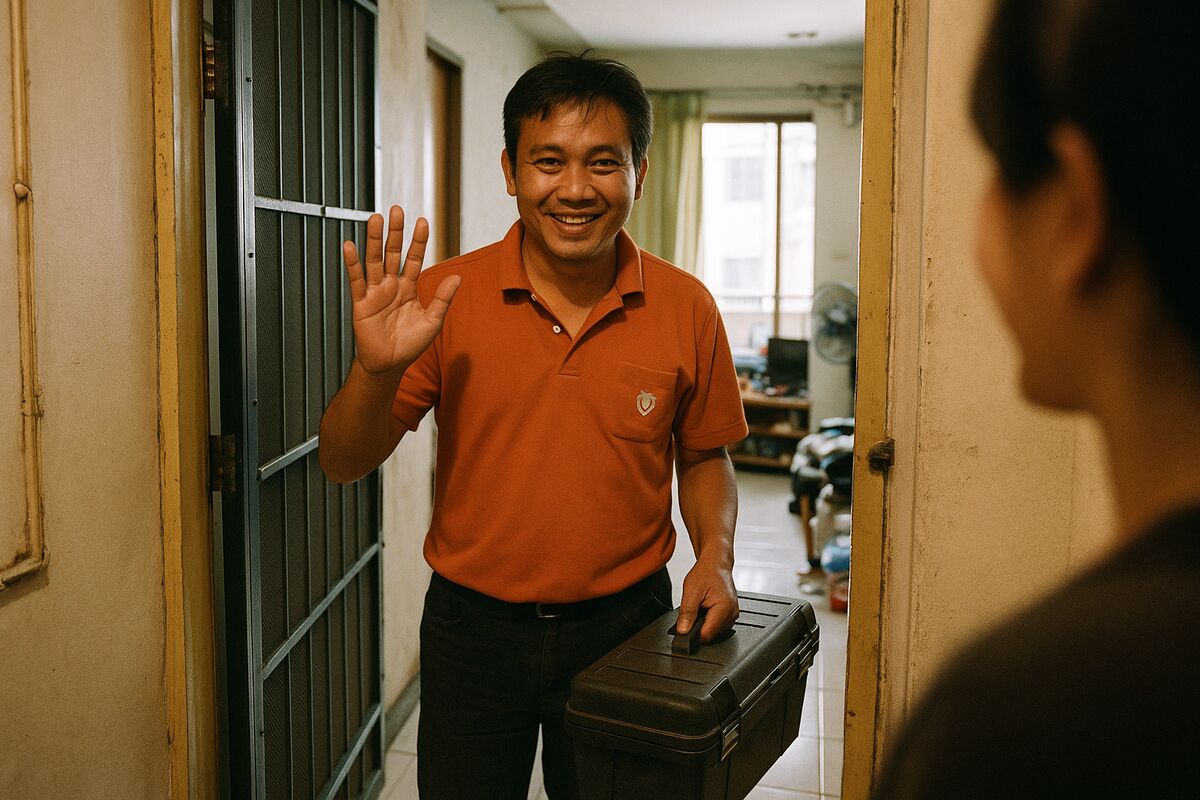
Walk into any large hardware store in Thailand, or spend five minutes on a marketplace app, and you can buy the same active ingredients the professionals use: fipronil gel bait, cypermethrin concentrate, termiticide sprays, insect growth regulators. The listings say so, loudly, often with the word เกรดมืออาชีพ — professional grade — right in the product name.
Which raises a fair question: if the chemicals are for sale, why pay a company ฿1,990 to apply them? It's the sharpest version of the DIY pest control chemicals Thailand debate, and it deserves a sharper answer than the pest control industry's usual leave it to the pros hand-waving.
So here's the honest version, from a company with an obvious interest. Full disclosure: PestsRova is our own service — judge our conclusions with that in mind, and hold us to the same criteria we apply to the DIY route. Spoiler: DIY genuinely wins in more situations than companies like ours tend to admit, and loses badly in a few where people least expect it.
What You Can Actually Buy in Thailand — and What the Law Says
Thailand's retail market for pest products is unusually well stocked. Commonly available to anyone:
- Cockroach and ant gel baits using actives like fipronil, imidacloprid and hydramethylnon — consumer cousins of the professional baits (we use Bayer Maxforce in this category ourselves)
- Pyrethroid sprays and concentrates — cypermethrin, deltamethrin and friends — as ready-to-use aerosols or dilutable concentrates from agricultural supply shops
- Termite-labelled sprays and soil-drench products for surface application
- Dusts, chalks, glue traps, bait stations and growth regulators
Now the legal frame, in general terms: pesticides in Thailand are regulated as hazardous substances under the Hazardous Substances Act. Household pest products fall under Thai FDA oversight and must carry a Thai registration on the label; agricultural pesticides answer to the Department of Agriculture; and commercial pest control operations require licensing, trained applicators, and controlled handling of professional formulations. In practice this creates three tiers: products anyone may buy and use per the label; products sold openly but formulated and labelled for agricultural or professional contexts; and restricted formulations legitimately available only to licensed operators.
The practical takeaways for a DIY buyer:
- Buy Thai-registered products with Thai labels. An unregistered import from a marketplace seller has skipped the safety review that the registration system exists to provide, and the label may bear little relation to the bottle.
- The label is the law and the instruction manual. Dilution rates, permitted locations, re-entry times. Professional users are trained to treat labels as binding; DIY users should too.
- Grey-market pro formulations are a bad buy even when a listing will happily ship them — not mainly because of enforcement risk to you, but because concentrated products assume calibrated equipment and training you don't have.
DIY Pest Control Chemicals vs a Licensed Thailand Company: The Honest Comparison
| Attribute | DIY with store-bought chemicals | Licensed company (PestsRova) | |---|---|---| | Upfront cost | A few hundred baht per product | Flat ฿1,590–฿4,990 per visit by home size, any common pest; 15% off first visit | | What you're buying | The chemical only | Inspection, identification, placement, dosing, documentation | | Product access | Consumer formulations | Professional lines — BASF Termidor HE, Exterra, Bayer Maxforce | | Diagnosis | Yours — guesswork unless you research | Free pest ID; techs find harbourages and entry points | | Safety management | Your reading of the label; risk concentrates with kids and pets | Licensed and insured; pet-safe products and placements as standard | | If it fails | Buy more, try again | Free re-treat within 30 days; unlimited on year packages | | Documentation | None | Photo and treatment report every visit — useful with landlords and juristic offices | | Termites | Effectively unavailable at any DIY skill level | Inspection ฿990 (free with packages); programs ฿5,000–15,000 quoted in writing |
The table's real lesson sits in the second row: a company isn't charging you ฿1,990 for chemicals. Product cost is a small slice of any professional visit. You're paying for the part of pest control that isn't in the bottle — knowing that the roaches are German and not American (which changes everything), that the trail disappearing into the window frame means a wall-void nest, that gel dots belong at hinge lines and warm motor housings rather than along skirting boards where someone will mop them away.
Where DIY Pest Control Chemicals in Thailand Genuinely Win
Credit where due — the DIY route is the right call surprisingly often:
- Early, minor cockroach activity. A quality fipronil gel bait, applied as many small dots inside cracks, cabinet hinges and under appliances, is the single best consumer weapon in Thailand. Caught early, a light German cockroach problem can end for under ฿500.
- Ant trails with a visible source. Bait the trail, resist the urge to spray it (spraying scatters and splits colonies), and patience usually wins.
- Prevention and maintenance. Drain covers, door sweeps, sealant, glue traps as monitors — unglamorous, cheap, and more valuable than any chemical.
- Remote areas. Outside service coverage, competent DIY beats no treatment.
- People who enjoy doing it properly. Reading labels, rotating actives to avoid bait aversion, placing methodically. A careful amateur beats a careless professional — and careless professionals exist.
Notice what these cases share: small populations, accessible harbourages, forgiving margins for error. That's the DIY sweet spot, and inside it we'd honestly rather you spend ฿400 than call us.
Where DIY Reliably Loses
- Established infestations. By the time roaches appear in daylight, the visible insects are the overflow. Consumer bait quantities and amateur placement rarely reach the breeding core, and each failed round teaches survivors to avoid your bait. This is the pattern behind why DIY cockroach sprays fail — repellent sprays kill the visible 5% and scatter the rest deeper into the walls.
- Bed bugs. The consumer-spray success rate is dismal: they hide where sprays don't reach, eggs shrug off most contact products, and half-treatments spread them into neighbouring rooms. This one is a professional job, sometimes several.
- Termites — the flagship case. Killing the termites you can see is genuinely counterproductive; they're expendable foragers from a colony that may be metres away, and alarming it just reroutes the damage. Real control means a continuous treated soil zone (drilled and injected with equipment no household owns — the professional application matters as much as the Termidor in the tank) or a monitored baiting system like Exterra. That's why termites are our one pricing exception: ฿990 inspection first, then a written quote of ฿5,000–15,000, because honest termite pricing requires seeing the building. The full cost landscape is in our termite treatment cost guide.
- Homes with pets and small children. Not impossible for DIY, but the error margin shrinks: cats and pyrethroids are a genuinely dangerous combination, fish tanks and foggers worse. Professional placement exists partly to keep actives where animals can't reach them.
- Anything requiring documentation. Landlord disputes, condo juristic negotiations, food-business inspections. A receipt for spray from a hardware store settles nothing; a licensed company's photo and treatment report settles most things.
The Safety Gap: What Training Actually Covers
The uncomfortable part of the DIY conversation isn't effectiveness — it's that the licence a professional company holds mostly exists for safety, and the safety content is precisely what a marketplace listing doesn't ship with the bottle.
What applicator training covers, and what a DIY user has to reconstruct from labels and luck:
- Dosing discipline. Concentrates are formulated for dilution to a specific rate. The intuitive more-is-stronger instinct is exactly wrong: over-application increases residue on surfaces your family touches without meaningfully improving kill rates, and with baits it can make the deposit repellent instead of attractive.
- Placement rules. Never on food-contact surfaces, never where children reach, never where mopping redistributes it. Crack-and-crevice placement isn't fussiness; it's how actives stay effective and away from people simultaneously.
- Species-specific animal hazards. Cats lack the liver enzymes to process pyrethroids efficiently — a treated surface a dog shrugs off can put a cat in a veterinary emergency. Fish and aquatic tanks are extremely sensitive to airborne pyrethroids; foggers and open tanks in the same room end badly. Birds and reptiles carry their own sensitivities.
- Mixing prohibitions. Combining products, or applying a spray over an existing bait placement, at best cancels the bait and at worst creates exposure the labels never contemplated. One active, applied correctly, then patience.
- Ventilation and re-entry. Every registered label states how long a treated space needs before normal use. The people most commonly hurt by household pesticide misuse are the ones who never knew that line existed.
None of this means a careful adult can't use consumer products safely — millions do. It means the honest comparison isn't chemical vs chemical; it's a system that has these rules built in versus one where you are the safety system. With a baby crawling on the floor or a cat patrolling the kitchen counters, that difference is worth more than the ฿1,500 you'd save. It's also, frankly, why we lead with gel baits and pet-safe placements in our own residential work: the safest chemical is the one that never leaves the crevice it was placed in.
A Sensible Hybrid: Let Each Side Do What It's Good At
The framing of chemicals-versus-company is slightly false anyway. The strongest approach for most Thai homes uses both:
- DIY the prevention layer — sealing, drain covers, moisture control, glue-trap monitoring — permanently and cheaply.
- DIY the first response to minor, identified problems with a Thai-registered gel bait, applied by the label.
- Escalate on evidence: if activity persists past two or three weeks of correct baiting, or you're seeing egg cases, daytime roaches, wings, mud tubes or bites, stop spending on products. You're past the DIY sweet spot, and further attempts mostly train the survivors.
- Use professional visits to reset to zero, then hold the line yourself. One properly executed general pest control treatment with a 30-day re-treat guarantee, followed by your own prevention, beats a drawer full of half-used bottles.
If you're curious what we actually bring through the door, our products page lists the lines we use — BASF Termidor HE and Exterra for termites, Bayer Maxforce for baiting — and why each earns its place. No mystery fog.
The Five Most Expensive DIY Mistakes We Get Called After
We see the aftermath weekly, so consider this a free inspection of the failure modes — each one turns a cheap problem into a costly one:
- Spraying where you should bait. Repellent aerosols over cockroach harbourages scatter the population into new rooms and make subsequent baiting harder. The visible kills feel like progress; the colony disagrees.
- Bait next to spray. Laying gel bait on freshly sprayed surfaces contaminates it — roaches won't touch it, and the DIY verdict becomes baits don't work when the real verdict is chemistry 101.
- One big blob instead of many dots. Gel bait works as dozens of pea-sized placements deep in cracks near activity. A single generous smear on the counter feeds three roaches and dries out.
- Treating termite mud tubes with spray. Satisfying, visible, and counterproductive — the colony seals off the disturbed route and quietly opens another, often somewhere you can't see. Money spent here typically increases eventual treatment cost.
- Stopping at the first quiet week. Eggs hatch on their own schedule. Declaring victory after seven silent days, discarding the traps and relaxing the prevention is how round two arrives pre-adapted.
Avoid those five and your DIY success rate roughly doubles. Commit any two of them against an established population and you've usually spent enough baht and weeks that a professional visit would have been the economical choice from day one.
The Verdict
Buy the gel bait. Genuinely — a Thai-registered fipronil gel and twenty minutes of careful placement is the best few hundred baht in household pest control, and any company that tells you otherwise is protecting its invoice, not your kitchen. But know where the ground shifts: established infestations, bed bugs, anything with pets in the blast radius, anything needing paperwork — and above all termites, where DIY isn't merely weaker but actively counterproductive. The chemical was never the hard part. Knowing where, how much, and whether it's working — that's the part that was always for sale at a different counter.
Unsure which side of the line your problem is on? Send a photo to LINE @pestsrova or through our contact page — pest identification is free, and if it's a ฿400 DIY fix we'll say so. If it's not, flat per-visit pricing by home size is on our pricing page, guarantee included.
Frequently asked questions
Can I buy professional pest control chemicals in Thailand?
Yes, to a point. Consumer versions of professional products — fipronil and imidacloprid gel baits, pyrethroid concentrates, termite sprays — are sold at hardware chains, agricultural shops and online marketplaces. However, pesticides in Thailand are regulated as hazardous substances, and certain professional formulations and use cases are restricted to licensed operators. Always check the label is Thai-registered and follow it exactly.
Is DIY pest control cheaper than hiring a company in Thailand?
Per attempt, yes: quality gel bait costs a few hundred baht against ฿1,590–฿2,490 for a professional condo visit. Per solved problem, it depends. DIY wins on minor, early cockroach or ant issues treated correctly. Repeated failed attempts, bait aversion, or an established infestation flip the maths toward one properly executed professional treatment with a guarantee.
Are professional pest chemicals dangerous to use at home?
Used exactly per the Thai-registered label, consumer formulations are engineered for household use. The real risks are behavioural: over-applying concentrates, mixing products, treating food surfaces, and skipping gloves. Pets add hazard — pyrethroids are dangerous to cats and fish in particular. Gel baits in cracks and crevices are the safest DIY format; broadcast spraying indoors is where most self-inflicted problems happen.
Should I treat termites myself in Thailand?
No — this is the one pest where DIY reliably fails. Effective control means either a continuous treated soil zone, applied through drilling and injection with proper equipment, or a professionally monitored baiting system. Spraying visible termites kills scouts while the colony continues eating. A licensed inspection (PestsRova charges ฿990, free with packages) should precede any termite spending.
Need it handled professionally?
Get a fixed quote for your Bangkok property in under 60 seconds.
Written by the PestsRova Team
We're Bangkok's documented pest control crew — everything we write comes from real treatment visits across homes, condos and short-stay rentals.
Get our Bangkok pest guides straight in Google — add PestsRova as a preferred source.
Add on Google