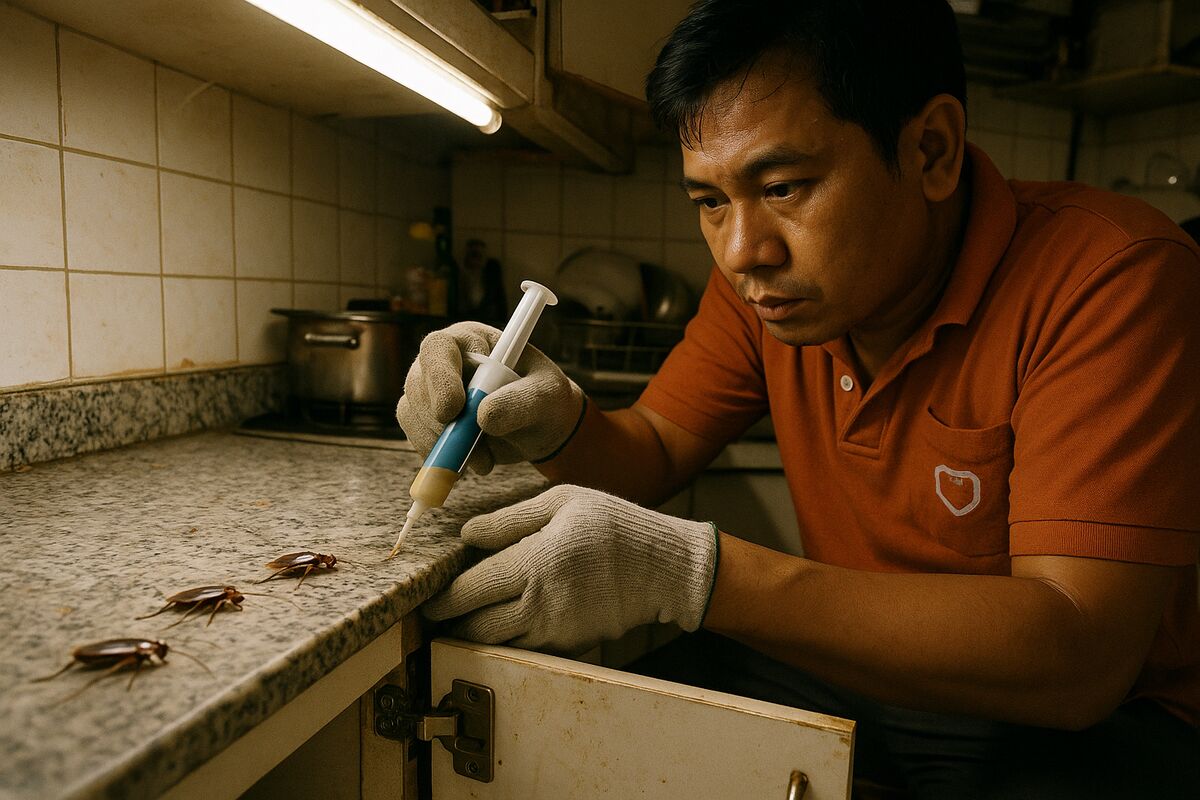
Most people have never seen cockroach eggs, because cockroaches don't lay eggs the way you'd picture. There's no cluster of tiny white spheres. Instead, the female produces a single hard-shelled capsule called an ootheca, about the size of a grain of rice to a small bean, which holds anywhere from a dozen to nearly fifty embryos. She either carries it around or glues it somewhere dark and close to food.
That capsule is the reason cockroach problems "come back" after you thought you'd dealt with them. Kill every adult in the kitchen tonight and the oothecae tucked into the cabinet hinge will still hatch on schedule in a few weeks. Finding and dealing with cockroach eggs is the difference between a treatment that holds and one that resets.
This guide shows you how to identify an ootheca, tell which species laid it, understand what it means for your Bangkok home, and stop the next generation from emerging.
What an ootheca looks like
An ootheca is a small, oblong, purse-shaped capsule with a ridge or seam running along one edge. That seam is where the nymphs will eventually push out. Key features:
- Size: roughly 5–10 mm long depending on species
- Colour: light tan through to dark reddish-brown or nearly black, darkening as it ages
- Texture: smooth, slightly glossy, hard to the touch (it's made of a protein similar to the exoskeleton)
- Shape: like a tiny kidney bean or a miniature purse, with fine ridges across it
- Weight: almost nothing; it's easy to mistake for a seed, a mouse dropping, or a bit of dried food
If you find one and it has one end open or split along the seam, it's already hatched. If it's intact and firm, it may be viable.
Which cockroach laid it?
In Bangkok homes you'll mostly encounter two species, and their oothecae are quite different, which is useful because the species dictates where to look and how urgent the problem is.
| Feature | German cockroach ootheca | American cockroach ootheca | |---|---|---| | Length | About 6–9 mm | About 8–10 mm | | Colour | Light tan to yellowish-brown | Dark reddish-brown to nearly black | | Shape | Slender, more elongated | Stouter, more bean-shaped | | Number of eggs | Around 30–48 | Around 14–16 | | Where you'll find it | Rarely, because the female carries it until hatching; spent cases in the harbourage | Glued to surfaces near food and water: under shelves, behind appliances, inside cardboard, in drain voids | | Time to hatch | Roughly 3–4 weeks from formation | Roughly 5–8 weeks | | Cases per female lifetime | Several, often 4–8 | Many, potentially dozens |
The single most useful thing to know: German females carry the ootheca protruding from the abdomen until a day or so before hatch, then drop it in the harbourage. American females glue it down within a day or two of forming it and move on.
So if you find intact tan oothecae lying loose in a kitchen cabinet, that's German, and the harbourage is right there. If you find dark brown oothecae stuck to the underside of a shelf or the back of the fridge, that's American, and the female has been foraging through that spot.
If you've seen adults too, our German vs American guide will confirm the match.
Where to look for cockroach eggs in a Bangkok home
Cockroaches put oothecae where they're warm, protected, and near food and water. In a typical Bangkok condo or shophouse, that means:
Kitchen
- The hinge side of cabinet doors and the top rail of drawers
- The underside of the sink and the pipe entry in the cabinet floor
- Behind and beneath the fridge, especially around the motor housing and drip tray
- The rear of the microwave, rice cooker, and kettle base
- Inside the cardboard of delivery boxes and egg cartons that have been sitting around
- The gap between the countertop and the backsplash
Bathroom and utility
- Behind the water heater
- Under the vanity, around the waste pipe
- The housing of the floor drain, for American cases
- Behind and under the washing machine
Elsewhere
- Inside the aircon unit housing, which is warm and damp
- Cable trays and ducting above false ceilings
- Stacked cardboard, newspapers, or storage boxes
- The back of wardrobes against an external or bathroom wall
American oothecae in particular show up in cardboard. If you get regular deliveries, break the boxes down and get them out the same day. A glued ootheca in a box that sits in a corner for a month is a classic way to import a problem.
What finding an ootheca tells you
A few things, all useful:
- There's a breeding female nearby. Oothecae don't travel far from where they were formed. One intact case in a cabinet means a mated female has been living in or passing through that cabinet.
- The population is established. A single foraging adult doesn't leave egg cases. A female that's laying has food, water, and a harbourage.
- The clock is running. A viable German ootheca is weeks from releasing 30–48 nymphs into the spot you found it. Those nymphs are mature and breeding in a couple of months in a warm kitchen. We've written about what to do when you see baby cockroaches, and the answer begins with finding the oothecae.
- Spent cases tell you about history. Empty, split oothecae in a cabinet mean hatches have already happened there. The more you find, the longer the colony has been resident.
How to deal with the ones you find
The good news: an ootheca you can see is an ootheca you can remove. Unlike adults, it can't run.
- Pick it up. Gloves, tissue, or tape. Don't crush it in place; the embryos are protected by the shell and you may just scatter viable material into the crack.
- Destroy it. Crushing thoroughly works. So does sealing in a bag and putting it in the freezer for a day before binning. Flushing is fine too. Don't just drop it in the kitchen bin; an intact case can hatch there.
- Vacuum the area. A crevice-tool pass around where you found it picks up any others you missed, plus droppings and shed skins. Empty the vacuum outside.
- Clean the spot. Warm water and detergent remove the aggregation pheromone in the droppings that tells other cockroaches this is a good place to live.
- Look for more. Where there's one there are usually several. Work outward from the find.
That handles the visible ones. The problem is the ones inside the void, behind the cabinet carcass, or carried on a German female you haven't seen yet.
Why sprays don't work on cockroach eggs
The ootheca's shell is a protein casing that's essentially impermeable to insecticide. A residual spray across the surface does nothing to the embryos inside. Neither does gel bait, which only works when eaten. The nymphs will hatch through a treated surface and a dry bait placement a few weeks later, which is the mechanism behind the "I sprayed, it worked, they came back" experience that fills Bangkok expat forums. The wider problem with aerosol-only approaches is covered in why DIY cockroach sprays fail.
There are two ways round this:
Timing. A follow-up treatment two to four weeks after the first one catches the nymphs as they hatch, before they're old enough to breed. This is why a single visit is rarely the end of a German problem and why we structure treatment in cycles.
Insect growth regulators. An IGR such as hydroprene or pyriproxyfen doesn't kill the eggs, but it affects the nymphs that emerge. They either fail to complete development into breeding adults or come out sterile. Applied to the harbourage, it means the hatch that's already scheduled doesn't produce a next generation. Professional treatments for an established colony almost always combine gel bait (for the adults) with an IGR (for the pipeline).
What a professional does about egg cases
When our technicians find oothecae or evidence of breeding, the treatment plan shifts in a few ways:
- Physical removal. Any accessible oothecae are picked up, and the harbourage is vacuumed with a crevice tool before products go in.
- IGR in the harbourage zone. Placed into the voids and cracks where the eggs are, so emerging nymphs are exposed immediately.
- Gel bait around the harbourage. Small dots in the cracks, not on surfaces, so adults and older nymphs feed on it and transfer the active back into the colony. We explain the full logic in our gel bait vs spray article.
- Dust into the void. Where the colony is inside a cabinet carcass or wall void, insecticidal dust gives a long-lasting residual in a space spray can't reach.
- A scheduled follow-up. Timed to the hatch window for the species found.
All of this is pet- and kid-safe when placed properly: bait and dust live inside cracks and voids, and nothing goes on surfaces you touch. Every visit ends with a photo and treatment report showing what was found, including the oothecae, and where products went. Identification of the species is included at no charge, and pricing is flat by home size rather than by pest, so a 1BR is ฿1,990 per visit and a 2BR ฿2,490 whether the case turned out to be German or American. The full table is on the pricing page.
Special cases: shophouses, condo stacks and cardboard
A few Bangkok-specific patterns worth knowing.
Shophouses. Stacked stock, flattened boxes, and a ground-floor food business next door are an ootheca distribution system. American females glue cases into cardboard and the cardboard gets moved upstairs or into storage. If you run a shop or restaurant, the storage area needs the same inspection as the kitchen, and documentation from a licensed contractor is useful at inspection time. Our commercial programmes cover both.
Condo stacks. German oothecae don't travel between units by themselves, but adults carrying them do, via the gaps around the service riser. If your neighbour's kitchen has an established colony, gravid females will find their way along the pipe chase and drop cases in your cabinets. Sealing the penetrations is the unit-side fix; the building-side detail is in keeping cockroaches out of a Bangkok condo.
Second-hand furniture and appliances. A used fridge or a wooden cabinet from a moving-out sale is a very common way oothecae arrive in a clean unit. Check the back and underside before it comes through the door, and vacuum the motor housing of any used appliance.
Deliveries. Egg cartons, fruit boxes, and online-order packaging. Break down and bin same day, ideally outside.
Preventing the next batch
Once the colony is gone, keeping it gone comes down to removing what a laying female needs.
- Water. Fix drips, dry the sink overnight, keep the under-sink cabinet dry. A damp cabinet floor is the best German nursery in a Bangkok condo.
- Cracks. Silicone the countertop-to-wall gap, the pipe penetrations, and the hinge gaps on cheap cabinets.
- Cardboard. Don't store it.
- Grease. Extractor filter and hob surround, cleaned regularly.
- Heat. Pull the fridge out and vacuum the motor housing every few months.
- Follow-ups. If you've had an established colony, a year package with scheduled visits catches any late hatch before it matures. The 4-Visit Year Package from ฿4,590 works out to four visits for less than the price of three, and covered pests returning between visits are re-treated free with no cap. Unused visits are refunded, and every package includes a free annual termite inspection, which in a Bangkok building is worth having regardless.
Found a capsule and not sure?
Take a photo of it next to a coin for scale and send it to us on LINE (@pestsrova) or WhatsApp. We'll tell you what it is and whether it's viable, free, before you book anything. If it's time for a proper look, book a general pest control visit or use the contact form: flat price by home size, 15% off your first treatment, photo report at the end, daily 8:00–20:00 with same-day emergencies until 22:00 across every BTS and MRT zone.
Frequently asked questions
What do cockroach eggs look like?
Cockroaches do not lay loose eggs. The female produces an ootheca, a hard, oblong, slightly glossy capsule 5–10 mm long shaped like a tiny kidney bean with a seam along one edge. German cases are light tan and slender; American cases are dark reddish-brown and stouter. It is easy to mistake for a seed, a mouse dropping or dried food. A split or open end means it has already hatched.
How long do cockroach eggs take to hatch?
A German cockroach ootheca hatches roughly 3–4 weeks after it forms, releasing 30–48 nymphs. An American cockroach ootheca takes roughly 5–8 weeks and releases 14–16 nymphs. Because the hatch happens on schedule regardless of what you sprayed, a follow-up treatment two to four weeks after the first one is what catches the next generation.
Does spraying kill cockroach eggs?
No. The ootheca shell is a protein casing that insecticide cannot penetrate, and gel bait only works when eaten, so neither touches the embryos inside. This is why cockroaches seem to come back a few weeks after a spray. Professionals pair gel bait for adults with an insect growth regulator so emerging nymphs cannot mature, plus a timed follow-up visit.
How do I get rid of cockroach egg cases I find?
Pick the case up with gloves, tissue or tape rather than crushing it in place, then crush it thoroughly, freeze it in a sealed bag for a day, or flush it. Do not drop it in the kitchen bin intact. Vacuum the area with a crevice tool, wash the spot with warm soapy water to remove aggregation pheromone, and search outward for more; there are usually several.
Need it handled professionally?
Get a fixed quote for your Bangkok property in under 60 seconds.
Written by the PestsRova Team
We're Bangkok's documented pest control crew — everything we write comes from real treatment visits across homes, condos and short-stay rentals.
Get our Bangkok pest guides straight in Google — add PestsRova as a preferred source.
Add on Google